
PERIMENOPAUSE · JOINT AND MUSCLE HEALTH
Can Perimenopause Cause Shoulder Pain?
Your shoulder has started hurting, and you cannot remember injuring it. Reaching for something on a shelf feels uncomfortable. Getting dressed takes more effort. Perhaps the pain wakes you at night, or you have started avoiding movements that used to feel ordinary.
Age, posture or sleeping position may seem like obvious explanations. Then you notice other changes too: disrupted sleep, unfamiliar aches, changes in your periods, or symptoms you have been trying to explain.
Could these things be connected? Muscle and joint pain are reported more often during perimenopause. Hormonal change could be one contributor for some women, but current research does not show that perimenopause directly causes shoulder pain in every case. A shoulder symptom alone cannot identify its cause.
If you are over 40 and making sense of several changes at once, it is reasonable to ask whether your hormones are part of the picture. It is also useful to consider shoulder conditions and other health causes that may need their own assessment.

What does research say about perimenopause and joint pain?
A 2026 systematic review and meta-analysis of 37 observational studies, including more than 93,000 women, found that muscle or joint pain was reported by about 57% of perimenopausal participants and 40% of premenopausal participants. The studies varied considerably, and most did not identify the specific cause or location of the pain.
This is evidence that muscle and joint pain are common during the transition. It is not proof that a particular shoulder symptom is caused by hormones. The same review found very limited research on specific shoulder diagnoses in perimenopausal women.
What the evidence can and cannot tell us
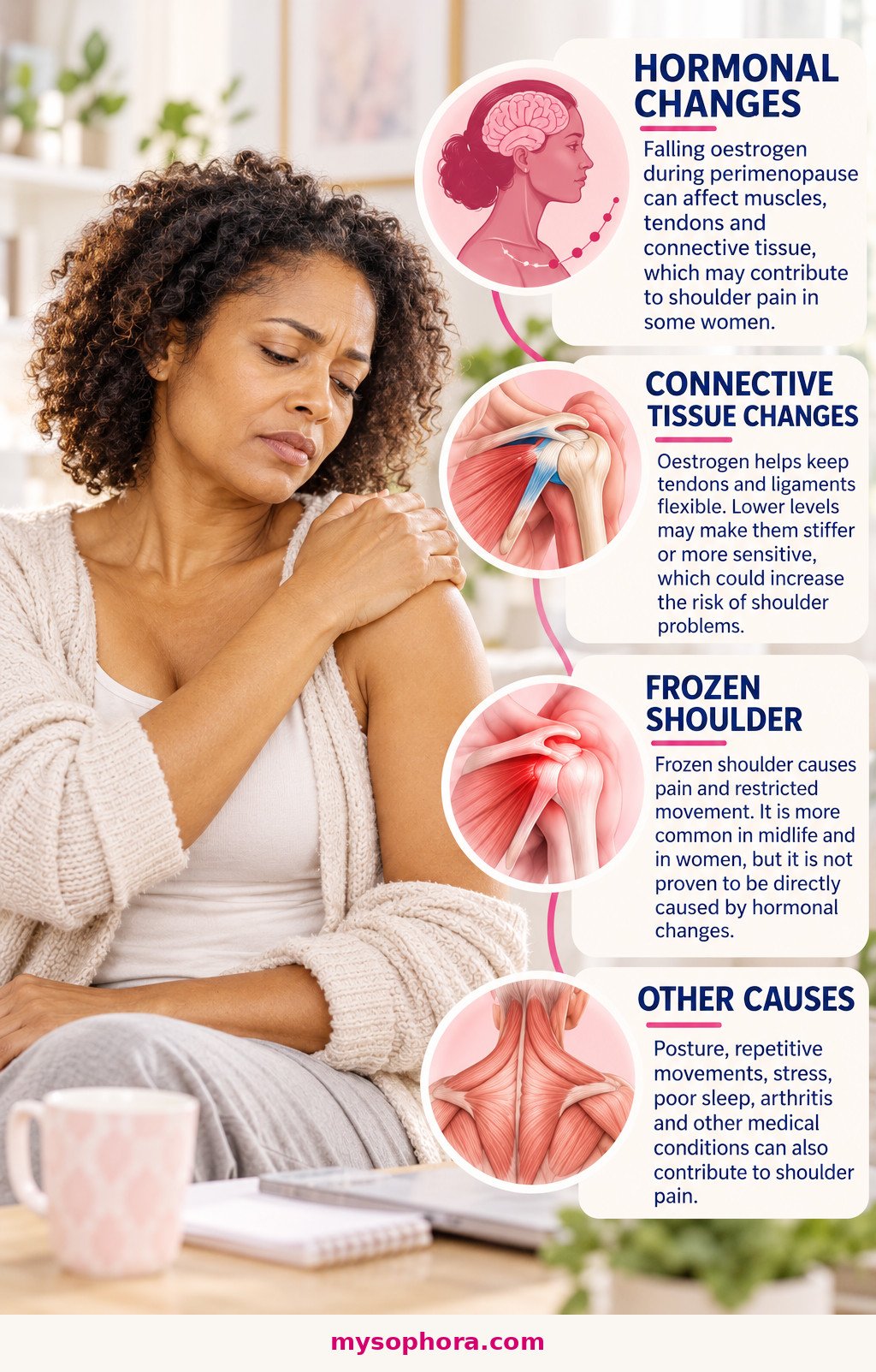
Oestrogen has biological effects on tissues involved in movement. Hormonal changes may contribute to musculoskeletal symptoms for some women, alongside age, previous injury, health conditions, activity, sleep and other factors.
The research supports taking new pain seriously. It does not support assuming every new ache is hormonal or using shoulder pain to measure oestrogen levels.
What could be happening in your shoulder?
The shoulder relies on muscles, tendons, ligaments and a joint capsule to move through a wide range. Pain can come from different structures, and symptoms can overlap.
Hormonal change may be one contributor
Oestrogen is involved in the biology of connective tissue and other tissues that support movement. Researchers are investigating how hormonal changes relate to pain and joint health. The exact contribution to one person’s shoulder pain is not yet clear.
Sleep and pain can affect each other
If night sweats, insomnia or repeated waking have left you tired, pain can feel harder to manage. Discomfort can interrupt sleep, while inadequate sleep can increase sensitivity to pain. This interaction does not mean the pain is imagined, and it does not identify what started it.
Frozen shoulder is one possibility
Frozen shoulder, also called adhesive capsulitis, causes pain and stiffness that make shoulder movement difficult. Reaching overhead, washing your hair, getting dressed or reaching behind your back may become harder. Pain can be worse at night.
Frozen shoulder is more common in midlife and is associated with conditions such as diabetes and thyroid disease. Research has explored a possible relationship with menopause, but it has not established that menopause causes frozen shoulder. Increasing stiffness or restricted movement deserves assessment.
The cause may be unrelated to perimenopause
Rotator cuff problems, tendon irritation, arthritis, injury and neck problems can cause shoulder pain. Sometimes pain felt around the shoulder starts elsewhere. The timing of symptoms is useful information to share with a clinician, but timing alone does not prove a hormonal cause.
Why can shoulder pain affect everyday life so much?
Shoulder pain can turn ordinary movements into tasks you have to think about. Reaching into a cupboard, washing your hair, lifting a bag or getting dressed may take more effort than before.
Getting dressed can become a negotiation with your shoulder. It is frustrating when a movement you barely noticed starts shaping your day.
Pain at night can affect the following morning, especially when sleep is already interrupted. At work, discomfort can make lifting, reaching, driving or sitting in one position harder. At home, it can interfere with exercise, household tasks and activities you enjoy.
You may also be trying to work out whether the shoulder pain, tiredness, sleep changes and other symptoms are connected. That is a reasonable question. The answer can involve more than one contributing factor.
What can you do about shoulder pain?
The right approach depends on the cause, how long the pain has lasted, how severe it is and whether movement is becoming restricted. Gentle movement is often preferable to keeping the shoulder completely still, but avoid forcing painful movement or starting strenuous exercises without guidance.
Notice the pattern
- When did the pain begin, and did it start suddenly or gradually?
- Was there an injury, unusual activity or change in routine?
- Is one shoulder affected or both?
- Which movements hurt or feel restricted?
- Does pain wake you at night or affect your sleep?
- Are you experiencing other changes in your health?
- Is the pain improving, staying the same or getting worse?
These observations can help you describe what is happening when you seek care. They cannot identify the underlying cause on their own.
Ask for an assessment if it persists or limits movement
Contact a healthcare professional if the pain is getting worse, does not begin to improve after about two weeks, keeps returning, affects sleep or daily activities, or makes moving your arm difficult. A clinician can examine the shoulder and decide whether tests, treatment or referral are appropriate.

When does shoulder pain need urgent attention?
Get urgent medical help for warning signs
Call your local emergency service if shoulder pain comes with chest pressure or pain, shortness of breath, sweating, faintness, or pain spreading to the jaw, back or arm. These can be signs of a heart attack.
- Seek urgent assessment for sudden severe pain, inability to move the arm, marked swelling or deformity, or pain after a significant injury.
- Get prompt medical attention if the shoulder is red or hot and you have a fever or feel acutely unwell.
- Persistent unexplained pain, a new lump, unexplained weight loss or other concerning symptoms also deserve medical assessment.
This list does not cover every situation. If you are worried something serious is happening, seek appropriate medical care.
Questions you may be asking
Can perimenopause cause shoulder pain?
Muscle and joint pain are reported more often during perimenopause, and hormonal change may contribute for some women. Research on shoulder-specific causes is limited. Shoulder pain can also come from a shoulder condition, injury, neck problem or another health issue, so the symptom alone cannot show that hormones are responsible.
Is shoulder pain a sign of low oestrogen?
No single shoulder symptom can show your oestrogen level or diagnose perimenopause. A clinician can consider your symptoms, health history and examination together.
Can perimenopause cause frozen shoulder?
Frozen shoulder is seen in midlife, and researchers have explored possible links with menopause. Current evidence does not establish that perimenopause causes it. A shoulder that is increasingly stiff or difficult to move should be assessed.
Can shoulder pain be worse at night?
Yes. Some shoulder conditions cause pain that becomes more troublesome at night or when lying on the affected side. Persistent night pain, especially when it disrupts sleep or is worsening, deserves assessment.
Will hormone therapy relieve shoulder pain?
Hormone therapy can help some menopause symptoms for suitable candidates, but it is not a guaranteed treatment for shoulder pain. Whether it is appropriate depends on your symptoms, medical history, preferences and individual benefits and risks. Discuss it with a qualified healthcare professional.
Should I take magnesium or another supplement for shoulder pain?
This article cannot recommend a supplement as a general treatment for shoulder pain. Evidence varies by supplement and condition, and supplements can have side effects or interact with medicines. Ask a healthcare professional, particularly if you have a health condition or take medication.
How can I tell whether my shoulder pain is hormonal?
There is no home test that can reliably establish this. The timing of the pain, other symptoms, your medical history and an examination can help a clinician assess possible explanations. More than one factor can be involved.
Understand the change without jumping to conclusions
When your shoulder starts hurting during a period of other bodily changes, it is natural to look for an explanation. Perimenopause could be part of the picture, but it is one possibility to consider alongside shoulder conditions and other causes.
Notice what has changed, how the pain affects your life and whether movement is becoming restricted. Seek assessment when symptoms persist, worsen or concern you, and get urgent help when warning signs appear.
Your shoulder pain deserves attention. The explanation should come from your symptoms and an appropriate assessment, rather than an assumption that every new midlife symptom is hormonal.
MEET SOPHORA
Make sense of what is happening to you.
When several changes arrive at once, it can be difficult to keep track of what you have noticed, what you have tried and which questions you still need answered.
Sophora is designed to help you organise your personal context, explore health information and prepare for conversations with a healthcare professional. It does not diagnose conditions or replace medical care.
Sources and further reading
The research below supports the general discussion of musculoskeletal symptoms and shoulder care. General menopause research does not establish the cause of an individual’s shoulder pain.
- Kruse C, et al. Musculoskeletal Manifestations of Perimenopause: A Systematic Review and Meta-Analysis of 93,021 Women. 2026. Includes pooled estimates and discusses limits in shoulder-specific evidence.
- NHS. Shoulder pain. Self-care guidance and when to seek assessment.
- NHS. Frozen shoulder. Symptoms, assessment and treatment information.
- NICE. Menopause: identification and management. Clinical guidance on menopause-related symptoms and care.