
By Sophora Editorial · Evidence reviewed · Published June 2026 · Last reviewed June 2026
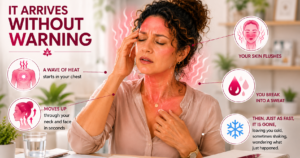
It arrives without warning. A wave of heat starts in your chest and moves up through your neck and face in seconds. Your skin flushes. You break into a sweat. And then, just as fast, it is gone, leaving you cold, sometimes shaking, wondering what just happened.
If you are in your 40s and this has started, you are not imagining it. Hot flashes are one of the most common symptoms of the menopause transition, although other causes of flushing and sweating are possible and new or unusual symptoms sometimes need medical assessment.
They can hit during the day or jolt you awake at night. They can be mild or genuinely life-disrupting, and for most women, they go on for years, not months.
Let’s talk about what a hot flash is, why your body is producing them, and what actually helps.
Someone important to you needs this too.
WhatsAppiMessageCopy LinkEmail
What is a hot flash?
A hot flash is a sudden rush of intense heat, usually across your chest, neck, and face. It lasts anywhere from one to five minutes. Your skin may go red or feel damp. Your heart may beat a little faster. When it passes, it often leaves a wave of cold or clamminess, which many women find just as unsettling as the heat itself.
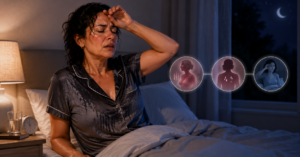
At night, the same thing happens during sleep. Those are called night sweats. You wake up drenched, disoriented, often unable to get back to sleep.
Doctors group hot flashes and night sweats under the term vasomotor symptoms. The name sounds technical; the experience is less subtle. A hot flash involves changes in the brain circuits that regulate temperature, followed by responses such as widening blood vessels near the skin and sweating. They are the most talked-about sign of the menopause transition and can start years before your last period.
What a hot flash typically feels like
- A sudden wave of heat rising through the chest, neck and face
- Skin flushing or going red
- Sweating, light or heavy
- Heart beating faster for a moment
- A chill or clamminess once it passes
- Usually lasts one to five minutes
- Can happen a few times a week or many times a day
Why is this happening?
Your brain has a built-in thermostat. It sits in a small area called the hypothalamus and keeps your body temperature steady without you having to think about it. Too warm, it makes you sweat. Too cold, it makes you shiver.
During the menopause transition, changing ovarian hormone signals affect the brain networks that regulate body temperature. Research points to a narrowing of the body’s thermoneutral zone: the small temperature range in which the brain does not call for sweating or shivering becomes even smaller.
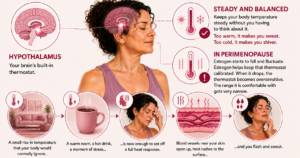
A small rise in temperature that your body would normally ignore, a warm room, a hot drink, a moment of stress, is now enough to set off a full heat response. Blood vessels near your skin open up, heat rushes to the surface, and you flash and sweat.
Anxiety can sometimes accompany or intensify the experience, but vasomotor symptoms are physiological events, not simply anxiety dressed up as heat.
What the hormones are actually doing
Estrogen does a lot more than manage your periods. It is involved in how your brain regulates temperature. Changing estrogen signalling affects a temperature-regulating network that includes specialised neurons in the hypothalamus. These neurons use several chemical messengers, including neurokinin B, and have become an important target for newer non-hormonal treatments.
Think of it as a thermostat whose comfortable range has become unusually narrow. The room has not suddenly turned into a sauna, but the control system is quicker to press the emergency cooling button.
A hot flash is a real heat-loss response generated by altered temperature regulation; the trigger does not require the room itself to be unusually hot.
Hot flashes and mood symptoms can occur during the same stage of life, and poor sleep from night sweats can make mood and concentration worse. Their relationship is complex, however, and it is too simple to assign both to one hormonal cause.
What the research actually shows
Around 70 to 75 percent of women get hot flashes during perimenopause. They are usually at their worst in the years just before and after the last period.
Here is the thing most women are not told: hot flashes do not just last a year or two. The largest long-term study on this, called the SWAN study, found the median duration of frequent vasomotor symptoms was 7.4 years.
Women who started getting flashes while their periods were still regular had the longest median duration, more than 11.8 years. Women who only started after their last period had the shortest median duration, 3.4 years.
That changes how you think about this. Hot flashes are not a brief blip to wait out. They are worth taking seriously and getting proper help for.
What the evidence says about treatment
- Works best: Hormone therapy (HRT): the most effective treatment available
- Evidence-based non-hormonal options: Certain SSRIs and SNRIs, gabapentin, fezolinetant, cognitive behavioural therapy and clinical hypnosis
- Comfort measures: Adjusting clothing, room temperature and bedding may make episodes easier to manage
- Insufficient or inconsistent evidence: Paced breathing and most supplements or herbal remedies should not be presented as proven hot-flash treatments
What you may have been told that is not true
Myth: Hot flashes only last a year or two.
The research says otherwise. In the SWAN study, frequent vasomotor symptoms lasted a median of 7.4 years, but individual experiences varied widely.
Knowing that is not meant to discourage you, it is meant to help you take it seriously and get real support instead of just waiting.
Myth: You just have to put up with them.
You do not. Hormone therapy is the most effective treatment for vasomotor symptoms. If you cannot or do not want to take hormones, there are non-hormonal prescription options that work too, including certain antidepressants at low doses.
Evidence-based non-hormonal options also exist, including certain SSRIs and SNRIs, gabapentin, fezolinetant, cognitive behavioural therapy and clinical hypnosis. Many women spend years in unnecessary discomfort without knowing any of this is available.
Myth: HRT is too dangerous.
The evidence on this has changed a lot in the past decade.
For many healthy, symptomatic women younger than 60 or within 10 years of menopause onset who have no contraindications, major menopause guidance considers the benefit-risk balance favourable.
This is a conversation to have with a doctor who knows you, not a one-size-fits-all rule.
Myth: If you are getting hot flashes, it must just be menopause.
Usually yes, but not always. An overactive thyroid, certain medications, and a few other conditions can cause the same feeling.
New, atypical or persistent symptoms should be assessed in context rather than diagnosed from one symptom alone.
What actually helps
Hormone therapy
HRT, sometimes called MHT (menopausal hormone therapy), is the most effective option. Treatment choice depends on symptoms, medical history, whether you have a uterus, and individual risks and preferences.
It is not right for everyone, and a good conversation with a doctor who is up to date on the evidence is the place to start.
Non-hormonal prescriptions
If you cannot or do not want to take HRT, there are other options. Certain antidepressants (SSRIs and SNRIs) work for hot flashes even at low doses, in women who are not depressed at all.
Gabapentin is another option, and fezolinetant is a non-hormonal medicine that acts on a brain pathway involved in temperature regulation. Suitability, side effects and monitoring requirements differ, so these choices need clinical guidance.
Know your triggers
Many women have specific things that reliably set one off: hot drinks, alcohol, spicy food, caffeine, a warm room, a sudden stress. Keeping a simple note for two or three weeks can show whether a suspected trigger is genuinely consistent for you. There is no need to ban every enjoyable thing in your kitchen on day one.
Slow your breathing
Slow breathing can be calming when a flash feels stressful, and some women like it as an in-the-moment coping tool.
It should not, however, be sold as a proven hot-flash treatment. Current evidence reviews do not recommend paced respiration as an effective therapy for reducing vasomotor symptoms.
Cool your bedroom
Night flashes are much worse in a warm room. Keep it cool. Use light, breathable bedding. Choose sleepwear and bedding by comfort, breathability and how easily you can change layers.
These practical adjustments may improve comfort, but evidence does not show that a particular fabric treats vasomotor symptoms.
Food and plant estrogens
Soy foods, tofu, tempeh and flaxseed can be part of a nutritious diet, but food should not be presented as a reliable treatment for hot flashes.
Studies of phytoestrogen approaches have produced inconsistent results. A balanced diet remains valuable for overall health during midlife without an unsupported promise that it will switch off a flash.
Exercise
Exercise does not reliably reduce the number of flashes. The evidence is mixed on that. But it does improve sleep, lift mood, and make the whole experience easier to live with. That is more than enough reason to do it.
“A hot flash is a real temperature-regulation event. Once you understand the mechanism, the next question becomes practical: which evidence-based option fits your health, symptoms and preferences?”
When to see a doctor
Before you go, use Sophora to get ready. The Symptom Decoder will help you understand exactly what is happening in your body. The Doctor Prep document inside your Sophora account gives you the right questions to ask, the information to bring, and the things most doctors skip over in a standard appointment. You will walk in knowing what you need, and knowing how to ask for it.
Go sooner rather than later if:
- You are under 40: flashes at this age need investigation
- Your flashes come with unexplained weight loss
- Your heart is racing or irregular and does not settle after a flash
- You have swelling or tenderness in your neck, or trouble swallowing
- Heat, sweating or palpitations feel continuous rather than episodic, especially with other new symptoms: ask for a clinical assessment rather than assuming menopause is the cause
- They are disrupting your sleep, work, or daily life: you deserve treatment
- You have just started a new medication: many drugs trigger flashes as a side effect
Questions you are probably asking
Can hot flashes start before my periods become irregular?
Yes. They can begin while your cycle still looks normal, as estrogen starts to fluctuate in early perimenopause. Women who get flashes at this stage tend to have them for longer, often a decade or more.
Is there anything I can do right now to get through the next one?
Keep your space cool and have a small fan close by. Dress in layers. Avoid known triggers in the two hours before bed. If slow breathing helps you stay calm, use it as a coping technique, but do not expect it to treat the underlying vasomotor symptom.
Will they stop on their own eventually?
For most women, yes, though it takes longer than most people expect. Frequency and intensity usually ease over several years. Treatment is not permanent; it can carry you through the hardest stretch.
Could this be my thyroid and not perimenopause?
It is possible. An overactive thyroid causes heat and sweating that feels similar. Symptoms alone cannot reliably separate the two. Hyperthyroidism can cause heat intolerance, sweating, tremor, weight loss and a fast or irregular heartbeat, while menopausal hot flashes are typically episodic. A clinician can assess the full symptom picture and order thyroid testing when appropriate.
In summary
Hot flashes arise from changes in the brain’s temperature-regulation system during the menopause transition, with changing estrogen signalling playing an important role. They are real, they are physical, and they affect most women in perimenopause. They also tend to last longer than people expect. The good news is that effective help exists, and you do not have to just wait it out.
Someone important to you needs this too.
WhatsAppiMessageCopy LinkEmail
Sophora can help you understand this
When a flash hits at 3am and you need to understand what your body is doing right now
The Symptom Decoder inside Sophora walks you through what is happening in your body in plain language, what is driving it, what connects to what, and what your options are. The Hormone Map shows you where estrogen fits into everything else you are feeling, so nothing catches you off guard.
If it happens at night, Right Now (3am Mode) is there. Built for the moment you wake up and need real support, not a page of reading.
Private. Account-bound. Never sold, never used for advertising, never used to train public AI models.
One payment. Twelve months. No subscription.
You’re Not Alone Anymore. Meet Sophora. Your Menopause Companion
Hot flashes are real. They involve changes in temperature-regulation pathways during the menopause transition. And they are treatable. You do not have to manage them alone.
References
- Freeman EW, Sammel MD, Lin H, et al. Duration of menopausal hot flashes and associated risk factors. Obstet Gynecol. 2011;117(5):1095–1104. (Penn Ovarian Aging Study)
- Avis NE, Crawford SL, Greendale G, et al. Duration of menopausal vasomotor symptoms over the menopause transition. JAMA Intern Med. 2015;175(4):531–539. (SWAN study)
- Thurston RC, Joffe H. Vasomotor symptoms and menopause: Findings from the Study of Women’s Health Across the Nation. Obstet Gynecol Clin North Am. 2011;38(3):489–501.
- Prokai-Tatrai K, Prokai L. The impact of 17β-estradiol on the estrogen-deficient female brain. Front Endocrinol. 2024;14:1310432.
- Prague JK, Roberts RE, Comninos AN, et al. Neurokinin 3 receptor antagonism as a novel treatment for menopausal hot flashes. Lancet. 2017;389(10081):1809–1820.
- Kronenberg F. Menopausal hot flashes: a review of physiology and biosociocultural perspective on methods of assessment. J Nutr. 2010;140(7):1380S–1385S.
- Harvard Health Publishing. Perimenopause: Rocky road to menopause. Harvard Medical School. Updated 2022.
- Pal L (Yale Medicine). Hot Flashes: How to Get Relief Before, During, and After Menopause. Yale Medicine, 2024.
Last reviewed: June 2026 · Review due: September 2026 · For education only. This is neither therapy nor medical advice. For your own use and understanding only. · mysophora.com