

Collagen for Women
A complete practical guide to skin, joints, tendons, bones, connective tissue, midlife and healthy ageing.
Collagen is structural protein. Your body makes it every day, using amino acids and vitamin C within a living system shaped by nutrition, movement, hormones, age and environment.

What collagen actually does
Collagen is the body’s most abundant structural protein. It helps give tissues strength, shape and resilience. Different collagen types are concentrated in different tissues, including skin, bone, cartilage, tendons and ligaments.
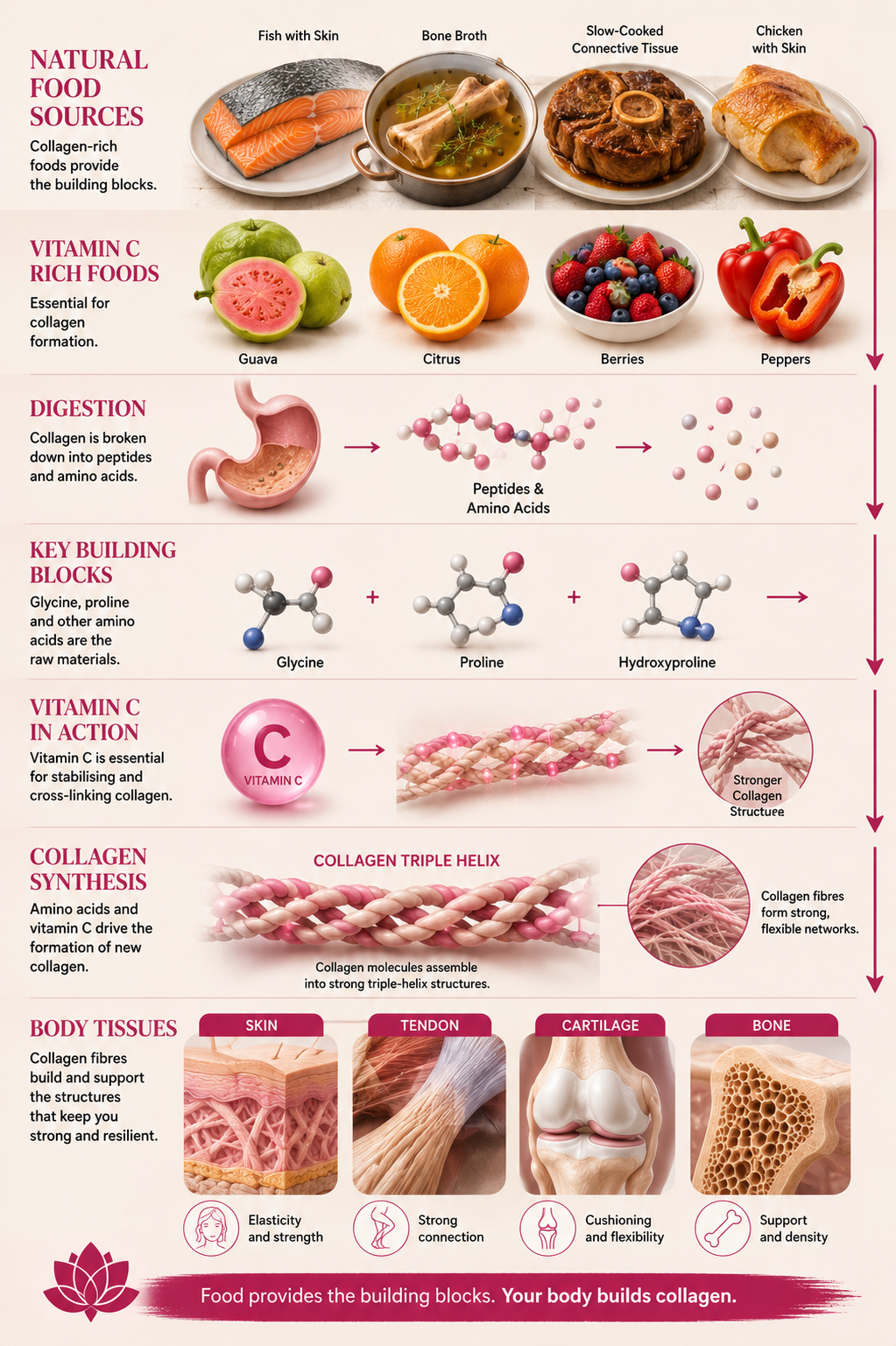
Your body builds collagen from amino acids, particularly glycine and proline. Vitamin C is essential for normal collagen formation. Overall protein intake, sufficient energy and micronutrients also contribute to the biological environment in which tissue repair occurs.
Collagen begins with biology, not a tub
Humans have long obtained collagen-rich tissues through animal foods and traditional preparations. Skin, bones, cartilage, tendons, fish skin and slow-cooked connective tissues provide collagen and gelatin. Broths and stews can contribute collagen-derived amino acids, although the amount varies with ingredients and preparation.
Your body also synthesizes collagen. A food-first foundation includes adequate total protein and vitamin C-rich foods such as citrus fruit, guava, berries, peppers, tomatoes and leafy vegetables. Plant foods do not contain collagen, but they can supply amino acids and micronutrients used in the body’s own collagen synthesis.
Food traditions across Africa, Asia, Europe, North America, South America and Oceania provide important context. Many cuisines use bone-in meats, fish skin, gelatinous cuts, soups and stews. These foods can be part of a useful whole-diet strategy, while standardized supplements provide more predictable doses for targeted use.
Support skin from the inside and outside
Skin contains a collagen-rich dermal matrix that contributes to firmness and structure. Collagen production and organization change with age. Menopause adds another biological transition because declining estrogen is associated with changes in skin thickness, hydration and collagen content.
Human trials and pooled research have reported improvements in measures including skin hydration and elasticity with some oral hydrolysed collagen products used consistently for several weeks.
Sun protection reduces a major environmental driver of collagen breakdown and visible skin ageing.
Provide a reliable supply of amino acids across the day.
Vitamin C is required for normal collagen formation.
Judge a skin-focused collagen routine over weeks, not days.
Connective tissue responds to load
Movement is one of the strongest signals your musculoskeletal system receives. Tendons, ligaments, cartilage, bone and muscle adapt to appropriate mechanical loading. Collagen supplementation fits best inside that larger system.
Research on collagen peptides and gelatin has explored joint comfort, exercise-related joint symptoms and connective-tissue collagen synthesis. The practical approach is to pair nutrition with progressive movement and recovery.
What you can do today
- Use progressive resistance training to strengthen muscles that support joints.
- Include weight-bearing activity appropriate to your ability and bone goals.
- Progress training load gradually so connective tissue can adapt.
- Prioritize sleep and recovery.
- If using collagen around training, consistency matters more than chasing a perfect minute on the clock.
Bone is mineral and collagen together
Bone is not simply calcium. Its organic matrix is rich in type I collagen, which provides a framework for mineral deposition. For women in midlife, bone support belongs in a broader plan that includes resistance exercise, weight-bearing activity, adequate protein, calcium, vitamin D and other relevant nutrients.
Studies of specific collagen peptides in postmenopausal women have produced encouraging findings for some bone markers and bone mineral density outcomes. Collagen is best positioned beside established bone-health foundations.
Use the right protein for the right job
Collagen is rich in glycine and proline but relatively low in leucine and lacks tryptophan. It is therefore not a complete protein and is not the strongest standalone choice for stimulating muscle protein synthesis.
For muscle preservation, build around sufficient total protein, complete protein sources and resistance training. Add collagen when connective tissue, joints, tendons, skin or bone are also part of your goal.
Why midlife changes the collagen conversation
Perimenopause and menopause change the context in which women think about collagen. Estrogen decline affects skin and bone biology, while ageing also influences muscle mass, tendon properties, recovery and tissue remodelling.
A useful midlife collagen plan is therefore wider than beauty. Think whole-body structural health: skin, bone, joints, tendons, muscle support, nutrition, movement and recovery.

Your collagen is shaped by more than age
Ultraviolet exposure contributes to skin collagen degradation. Smoking damages skin structure and repair. Inadequate nutrition, prolonged inactivity and insufficient recovery can also work against tissue health.
The positive side is that many inputs are modifiable. Sun protection, nutritious food, adequate protein, resistance training, regular movement, sleep and avoiding smoking create a stronger foundation for healthy tissue across the lifespan.
Supplements
How to choose and use collagen peptides
Hydrolysed collagen peptides are collagen proteins broken into smaller peptides for easier mixing and digestion. They are widely used in human research.
Skin, joints, tendons and bone use different study protocols.
Bovine and porcine collagen commonly provide types I and III. Marine collagen is usually type I dominant. Chicken-derived products can provide type II collagen.
Read the serving size and grams of collagen peptides per serving.
Many studies run for weeks or months. Build a routine you can maintain.
Your body still needs complete protein, micronutrients, movement, sleep and recovery.
Practical dose ranges
Human studies of hydrolysed collagen peptides commonly use approximately 2.5 to 15 g daily, depending on the outcome studied. Skin protocols often use lower daily amounts, while exercise and connective-tissue protocols can use larger servings. When a product has direct clinical research, the studied serving is a useful reference point.
Timing is flexible for general use. Some exercise-focused protocols use collagen or gelatin with vitamin C before loading exercise. The larger priorities remain consistency, adequate nutrition and repeated appropriate training.
Should you take collagen?
Start with the outcome you want, then match the tool to the job.

Collagen compared with other options
| Option | Best fit | Difference |
|---|---|---|
| Collagen peptides | Skin and connective-tissue focused goals | Distinctive peptide profile rich in glycine and proline. |
| Protein powder | Total protein and muscle support | Complete proteins such as whey provide more essential amino acids and leucine. |
| Creatine | Strength, repeated high-intensity performance and muscle support | Supports rapid cellular energy rather than supplying structural protein. |
| Vitamin C | Normal collagen formation | An essential cofactor in collagen synthesis, not a replacement for protein building blocks. |
| Calcium and vitamin D | Bone-health foundations where intake or status requires support | Support mineral and calcium biology rather than supplying collagen peptides. |
What to look for
- Hydrolysed collagen peptides with grams per serving clearly stated.
- Source disclosed, such as bovine, marine, porcine or chicken.
- A simple ingredient list when you do not need added extras.
- Independent quality testing where available.
- Clear allergen information, especially for marine products.
- A meaningful dose that matches your goal.
When to adapt the plan
Check marine collagen sources carefully and choose a safe source.
Review the full formulation and added ingredients, not just the collagen itself.
Count collagen within total protein intake and follow your individualized nutrition plan.
Use collagen as support while investigating injuries or underlying causes that need treatment.
A worldwide question with uneven representation
Collagen biology is universal, but supplement research is not evenly distributed. Relevant human research and research groups span Europe, Asia, North America, South America and Oceania, with international work in skin, connective tissue, musculoskeletal health and ageing.
African women and some other populations remain underrepresented in many specific collagen intervention questions. Sophora does not create artificial geographical balance by elevating weak evidence. Where population-specific research is thin, established human biology should be distinguished from intervention findings that still need broader representation.
Useful distinctions
Does collagen go straight to my skin?
No. It is digested into peptides and amino acids. Those materials enter the body’s wider amino-acid pool, while some collagen-derived peptides may also participate in biological signalling.
Is collagen useless because it is digested?
No. Digestion is how dietary proteins normally become usable. Human studies of hydrolysed collagen have reported measurable outcomes in several skin and musculoskeletal contexts.
Can collagen replace all my protein?
No. Collagen has a specialized amino-acid profile and is not a complete protein. Keep a varied protein intake, especially when muscle preservation is a priority.
Do I need an expensive collagen product?
No. Look for an appropriate source, meaningful dose, acceptable quality control and a format you can use consistently.
Collagen FAQ
How long does collagen take to work?
It depends on the goal. Skin research commonly assesses outcomes after several weeks. Connective tissue and bone remodel more slowly. Choose measurable outcomes and reassess after a realistic period of consistent use.
What is the best time to take collagen?
For general use, choose a time you will remember. Exercise-focused protocols sometimes use collagen or gelatin with vitamin C before training, but regular intake and appropriate loading exercise remain central.
Is marine collagen better than bovine collagen?
Neither is automatically better. Marine collagen is usually type I dominant. Bovine collagen commonly provides types I and III. Choose according to your goal, dietary preference, allergy status, quality and dose.
Can I take collagen and creatine together?
For many healthy adults, yes. They serve different purposes. Creatine supports rapid cellular energy and training performance. Collagen provides a connective-tissue-focused peptide and amino-acid profile.
Can I get collagen without supplements?
Yes. Your body synthesizes collagen, and collagen or gelatin can come from animal connective tissues and traditional foods. Supplements provide a standardized and convenient dose.
Build the tissue. Support the woman.
Collagen is part of your body’s structure, but healthy tissue is built by a system. Give that system protein, vitamin C, movement, progressive loading, sleep, recovery and protection from avoidable damage.
If collagen peptides match your goal, use them purposefully and consistently. Then measure what matters: how your skin feels, how your joints move, how your tendons tolerate training, how strong you are becoming and how well your body supports the life you want to live.
Your three-step plan
- Name your goal: skin, joint comfort, tendon support, bone, or a wider midlife tissue-health plan.
- Strengthen the foundation: adequate protein, vitamin C-rich foods, movement, resistance training, sleep and sun protection.
- Add collagen with purpose: choose the right source and dose, use it consistently and reassess the outcome that matters to you.
Sophora Bridge: Continue with Creatine for Women and Magnesium Glycinate to build a wider plan for strength, energy, recovery and healthy ageing.