
By Sophora Editorial · Evidence reviewed · Published June 2026 · Last reviewed June 2026
You have read the explanation now. You understand why your breasts have been sore. The hormones, the unopposed oestrogen, all of it. (click here if you havent)
What you actually want now, is for it to stop hurting, or at least hurt less, without reaching straight for a prescription.
There are real options here, some with stronger evidence behind them than others. You deserve to know which is which before you spend money or time on any of them.
What actually helps with sore breasts in perimenopause?
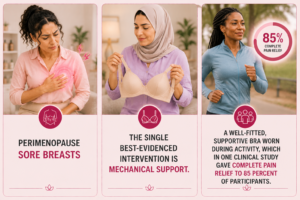
The single best-evidenced intervention is mechanical support. A well-fitting, supportive bra worn during activity, which in one clinical study gave complete pain relief to 85 percent of participants. Beyond that, magnesium and reducing dietary fat have modest supporting evidence, while evening primrose oil ,the most commonly recommended supplement has genuinely mixed results in rigorous trials. The honest picture matters more than a long list.
What the Evidence Actually Supports vs What Is Commonly Claimed
Not every remedy you will find online has equal evidence behind it. Here is an honest comparison.
| Approach | What the research shows |
|---|---|
| Supportive sports bra | Strongest evidence of any intervention here — one study found 85% of participants had complete pain relief |
| Magnesium supplements | Some clinical support, particularly taken in the two weeks before a period |
| Evening primrose oil | Mixed: smaller trials show benefit, but the largest meta-analysis of 13 trials and 1,752 women found no significant difference from placebo |
| Cutting caffeine | Widely recommended for decades, but the underlying research has never reliably confirmed it works |
| Reducing dietary fat | Some observational and small trial support, though evidence remains limited |
| Stress reduction / relaxation | One small trial found meaningful improvement in pain scores after 8 weeks |
What is actually happening when these approaches work
The mechanical and lifestyle approaches that show the strongest evidence work by reducing physical movement and fluid pressure in breast tissue, rather than by directly altering the hormonal imbalance causing the soreness.
A supportive bra limits the ligament movement that aggravates already-sensitive tissue throughout the day which explains why its effect is so immediate and consistent compared to supplements that work, if they work at all, by slowly shifting inflammatory pathways over weeks.
Magnesium’s modest evidence likely relates to its role in muscle relaxation and fluid balance magnesium can ease the water retention that contributes to breast swelling and tenderness, particularly when levels dip in the days before a period, even an irregular one.
Evening primrose oil’s inconsistent results make more sense once you know its proposed mechanism: it supplies gamma-linolenic acid, a fatty acid some women with breast pain have been found to have lower levels of, but supplementing it does not reliably translate into less pain across large trials, even though some individual women do report benefit.
According to a meta-analysis published via the National Center for Biotechnology Information, evening primrose oil showed no significant difference in breast pain reduction compared to placebo across thirteen randomised trials, which is a notably more rigorous and sobering conclusion than the marketing around this supplement usually suggests.
The thing that actually helps most is not the supplement everyone talks about. It is the bra nobody mentions, working quietly in the background of every ordinary day.
Someone important to you needs this too.
The Complete Picture: Building a Relief Plan That Actually Works
The most effective approach combines the highest-evidence options together. Consistent supportive bra wear, magnesium in the days before a period if your cycle still has any pattern, and reduced dietary fat rather than relying on a single supplement to do all the work. This matters because no single intervention here, including the best-supported one, eliminates breast pain entirely for everyone; the evidence supports meaningful reduction, not a guaranteed fix. A natural follow-up question is whether over-the-counter pain relief is worth using alongside these approaches. Topical anti-inflammatory gels containing ibuprofen or diclofenac, applied directly to the painful area, are a reasonable option with minimal systemic side effects, and oral NSAIDs can help for short, more painful stretches.
Why your doctor may not have told you this
A doctor’s appointment for breast pain is, appropriately, focused first on ruling out anything serious — that is the right priority. Once that reassurance is given, there is often limited time left to walk through the actual evidence quality behind each remedy, so patients are frequently handed a general list without the context of which options are well-supported and which are popular but unproven. You deserved the nuance, not just the list. That gap is not yours to carry.
What this means for the rest of what you are feeling
The same hormonal pattern behind your breast soreness is often behind other symptoms responding to similar lifestyle approaches — magnesium that helps breast tenderness can also ease muscle tension and sleep disruption elsewhere in your body. Supportive, practical changes rarely help just one symptom in isolation; they tend to ease the whole hormonal picture a little, even when they were chosen to target one specific complaint.
Questions you may be asking
What actually helps with sore breasts in perimenopause?
A well-fitted, supportive bra has the strongest evidence of any intervention, with one study showing 85 percent of participants achieved complete pain relief. Magnesium and reduced dietary fat have modest supporting evidence; evening primrose oil’s evidence is genuinely mixed despite its popularity.
Does evening primrose oil really work for breast pain?
The evidence is inconsistent — smaller trials have shown benefit, but the largest meta-analysis available, covering 1,752 women across thirteen trials, found no significant difference from placebo. Some individual women may still find it helpful, but it should not be treated as a guaranteed solution.
Should I cut out caffeine for breast pain?
This advice has been given for decades, but the scientific evidence behind it has never been consistent. Since there is little downside to trying, some women still choose to reduce caffeine, but it should not be expected to be a reliable fix on its own.
You now know: A supportive bra has stronger evidence behind it than most supplements marketed for breast pain.
One thing to do: Get properly fitted for a supportive bra, including a soft option for night wear, before spending money on supplements.
Hold onto this: You do not need to try everything. You need what actually works.
Someone important to you needs this too.
The next step
Your breast soreness is one part of a bigger picture — your cycle, your hormones, your sleep, all the changes you have been living through with no map for any of it. Sophora draws that map for you. Not a general guide. Your specific picture. Four steps. One session.
When
→
Where
→
What
→
Reveal
You do not need to try everything. You need what actually works.
Last reviewed: June 2026 · Review due: September 2026 · Not therapy. Not medical advice. For your own use and understanding only. This article discusses general approaches and is not a substitute for individual medical guidance. · mysophora.com