
By Sophora Editorial · Evidence reviewed · Published June 2026 · Last reviewed June 2026
It is not your whole breast. Nipple Pain in menopause ; It is one small, specific point ,the fabric of your shirt brushing past it, the seam of your bra catching it wrong, a sensation sharp enough to make you flinch in the middle of an ordinary moment.

You have checked, there is nothing visibly wrong, and yet this one small area has become unmistakably, distractingly sore. It feels too specific to just be “hormones.” It is, and the reason makes more sense than you might expect.
Why are my nipples so sore during menopause?
Nipple soreness during perimenopause is common because the nipple and areola contain an especially dense network of nerve endings, making this small area register hormonal fluctuation more intensely than the surrounding breast tissue. As oestrogen and progesterone shift unpredictably, that concentrated nerve supply is what turns a general hormonal change into a precise, localised soreness rather than a diffuse ache.
What is actually happening in your body
The nipple-areola complex is a densely innervated, highly sensitive region of the breast, measurably more sensitive than the surrounding breast tissue, which means hormonal changes affecting breast tissue generally are felt with particular intensity in this small area.
Clinical research measuring breast sensation point by point consistently confirms the nipple and areola together register touch, pressure, and vibration more acutely than the skin of the breast around them though studies differ on whether the nipple or the areola itself is the single most sensitive point, the nipple-areola complex as a whole is reliably the most responsive part of the breast.
This is simply how the tissue is built, and it means your experience of nipple soreness being sharper or more specific than general breast tenderness is not in your head it reflects real differences in nerve density.
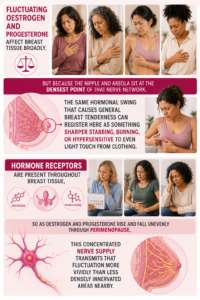
Fluctuating oestrogen and progesterone affect breast tissue broadly, but because the nipple and areola sit at the densest point of that nerve network, the same hormonal swing that causes general breast tenderness can register here as something sharper .
Stabbing, burning, or hypersensitive to even light touch from clothing. Hormone receptors are present throughout breast tissue, so as oestrogen and progesterone rise and fall unevenly through perimenopause, this concentrated nerve supply transmits that fluctuation more vividly than less densely innervated areas nearby.
According to Cleveland Clinic-USA, nipple soreness is one of the recognised symptoms linked to hormonal fluctuation during the menopause transition, alongside the broader breast tenderness covered elsewhere on this site, and tends to improve once oestrogen and progesterone settle at a lower, steadier baseline after menopause.
Your body was not overreacting, It was responding, with unusual precision, exactly in one of the places it was built to feel things most.
Someone important to you needs this too.
The Complete Picture: When It Is Hormonal and When It Is Not
Hormonal nipple soreness in perimenopause is typically present on both sides, fluctuates with whatever rhythm your cycle currently has, and tends to ease as hormone levels stabilise after menopause.
This matters because not every cause of nipple soreness is hormonal, and knowing the difference helps you decide what needs attention. Skin irritation from detergent, fabric, or an ill-fitting bra can cause similar soreness through simple friction rather than hormones.
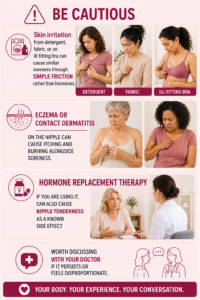
Eczema or contact dermatitis on the nipple can cause itching and burning alongside soreness. Hormone replacement therapy, if you are using it, can also cause nipple tenderness as a known side effect worth discussing with your doctor if it persists or feels disproportionate.
Why your doctor may not have told you this
Nipple soreness specifically tends to get folded into general breast tenderness during an appointment, rather than addressed as its own distinct symptom with its own explanation.
The nerve-density mechanism why this one small area feels things more sharply than the rest of the breast is genuine anatomy, but it rarely makes it into a short consultation focused on ruling out anything serious.
That reassurance is the right priority, but it can leave the actual “why” unexplained. That gap is not yours to carry.
What this means for the rest of what you are feeling
If nipple soreness has become part of your experience, it is very likely connected to the same fluctuating oestrogen and progesterone behind any broader breast tenderness, mood shifts, or cycle changes you have noticed.
The nipple is not a separate system reacting on its own it is simply the most sensitive part of a tissue responding, as a whole, to the same hormonal picture.
Questions you may be asking
Why are my nipples so sore during menopause?
The nipple and areola contain a dense concentration of nerve endings, which means hormonal fluctuation that affects breast tissue generally is felt with particular intensity in this small area. This is a normal anatomical response to changing oestrogen and progesterone, not a sign something is wrong.
Is nipple pain in perimenopause usually both sides or one side?
Hormonal nipple soreness is typically bilateral, affecting both sides similarly. New, persistent one-sided pain, especially with discharge, a lump, or skin changes, should be checked by a doctor rather than assumed to be hormonal.
Will nipple soreness go away after menopause?
For most women, yes — nipple soreness tends to ease once hormone levels settle at a lower, steadier baseline after menopause. Hormone replacement therapy can sometimes cause similar tenderness as a side effect, which is worth discussing with your doctor if it persists.
You now know: Nipple soreness is sharper than general breast tenderness because the nipple and areola are unusually nerve-dense — a real anatomical reason, not a mystery.
One thing to do: Notice whether the soreness is on one side or both — that single detail is genuinely useful if you ever need to describe this to a doctor.
Hold onto this: Sensitive does not mean wrong. It means built that way, doing exactly what it was built to do.
Someone important to you needs this too.
The next step
Your nipple soreness is one part of a bigger picture — your cycle, your hormones, your body’s whole response, all the changes you have been living through with no map for any of it. Sophora draws that map for you. Not a general guide. Your specific picture. Four steps. One session.
When→ Where→What→Reveal
Sensitive nipples does not necessarily mean that something is wrong. Now you have a great idea what could be the cause.
Last reviewed: June 2026 · Review due: September 2026 · Not therapy. Not medical advice. For your own use and understanding only. · mysophora.com