
By Sophora Editorial · Evidence reviewed · Published June 2026 · Last reviewed June 2026
A low-grade queasiness keeps showing up with no obvious cause .It’s not about anything you ate, nothing you can pin down, just a sense of feeling slightly off. Stress was the first guess. And then,you couldn’t quite pin anything else entirely, could you?

What nobody has mentioned is that this could be hormonal, arriving at the exact same time as everything else in your body has started to feel different. That connection is real, and it is worth knowing.
Can perimenopause cause nausea?
Yes. Nausea is a recognised, though under-discussed, symptom of perimenopause. Fluctuating oestrogen and progesterone affect the gut-brain axis and disrupt normal digestive signalling, producing a low-grade queasiness that is not linked to food, illness, or anything you can easily point to.
Perimenopause Nausea vs Early Pregnancy Nausea
Both can cause unexplained queasiness, and the overlap is exactly why this question comes up so often. Here is how they actually differ.
| Sign | Perimenopause Nausea | Early Pregnancy Nausea |
|---|---|---|
| Timing | Comes and goes unpredictably, often linked to cycle changes | Often worse in the morning, builds over the first trimester |
| Associated symptoms | Hot flushes, irregular periods, mood shifts | Breast tenderness, fatigue, missed period |
| Triggers | Often worse around hormonal fluctuation points in your cycle | Often worse with certain smells or on an empty stomach |
| Duration | Can persist intermittently for months or years through perimenopause | Typically eases after the first trimester |
| The only way to know | A pregnancy test or blood test, especially if your cycle is still irregular rather than absent. | |
What is actually happening in your body
Fluctuating oestrogen and progesterone disrupt the gut-brain axis .This is the constant communication line between your digestive system and your brain which can directly trigger nausea even when nothing is physically wrong with your stomach.
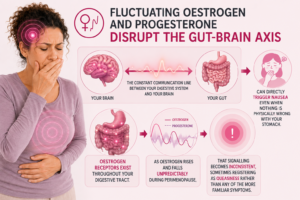
Oestrogen receptors exist throughout your digestive tract, and as oestrogen rises and falls unpredictably during perimenopause, that signalling becomes inconsistent, sometimes registering as queasiness rather than any of the more familiar symptoms.
Progesterone decline adds another layer. Progesterone normally has a calming effect on gut motility the speed at which food moves through your digestive system.
As progesterone drops unevenly in perimenopause, that calming effect becomes unreliable, and digestion can feel disrupted in ways that translate as nausea.
Cortisol dysregulation, common during this stage, compounds the effect further, since your autonomic nervous system the part of you that runs background processes without asking permission registers hormonal fluctuation as a stress signal that can manifest physically in your gut.
According to clinical research into menopause and digestion, gastrointestinal symptoms including nausea are a documented part of the wider symptom picture, even though they are far less commonly discussed than hot flushes or mood changes.
Your stomach is not malfunctioning on its own. It is receiving the same erratic hormonal signal that is changing your cycle, your sleep, and your mood your gut just happens to be where you feel it land first.
Someone important to you needs this too.
The Complete Picture: Hormones, Digestion and Why Nausea Shows Up
Perimenopause nausea happens because fluctuating oestrogen and progesterone disrupt gut-brain signalling and gut motility, and because the digestive system is densely populated with hormone receptors that respond directly to these shifts rather than staying neutral.
This means nausea rarely arrives alone many women notice it clustering with other symptoms during the same window, particularly fatigue, headaches, or a general sense of feeling unwell that does not match anything on a typical symptom checklist.
A natural follow-up question is whether diet changes help. Reducing trigger foods like caffeine or very fatty meals can ease symptoms at the margins, but because the underlying driver is hormonal rather than dietary, relief is usually partial unless the broader hormonal picture is addressed.
Why your doctor may not have told you this
Nausea without an obvious cause tends to lead toward investigations for digestive issues, food intolerances, or sometimes anxiety, because those are the more familiar explanations a short appointment has time to explore.
The hormonal connection is documented in research but rarely raised as a first possibility, particularly if your periods have not yet become noticeably irregular.
A food diary, or a suggestion that it is probably stress that is usually as far as it goes. Neither addressed what might actually be happening. That gap in the conversation is not yours to carry.
What this means for the rest of what you are feeling
If you are dealing with unexplained nausea, the same hormonal fluctuation is likely affecting other systems too, even if you have not linked them yet.
You might also be noticing headaches that come and go, fatigue that does not match your sleep, or a general sense of feeling unwell without a clear cause. One erratic hormonal pattern, moving through multiple systems, with your gut simply being where you feel it most directly.
Questions you may be asking
Can perimenopause cause nausea?
Yes. Nausea is a recognised but under-discussed symptom of perimenopause, caused by fluctuating oestrogen and progesterone disrupting gut-brain signalling. It often appears without a clear trigger and can come and go unpredictably over months or years.
Why does perimenopause nausea come and go?
Because the underlying hormonal fluctuation is itself unpredictable, nausea tends to follow the same erratic pattern rather than appearing on a consistent schedule. It may cluster around certain points in your cycle or appear with no obvious pattern at all, particularly as cycles become more irregular.
Does perimenopause nausea need treatment?
Mild, intermittent nausea linked to hormonal fluctuation does not usually require specific treatment, though dietary adjustments can help at the margins. If nausea is severe, persistent, or accompanied by other concerning symptoms, it is worth having it properly assessed rather than assuming it is hormonal by default.
You now know: Unexplained nausea in perimenopause is often linked to fluctuating oestrogen and progesterone disrupting gut-brain signalling, not a separate digestive problem.
One thing to do: If you track your nausea against your cycle for a few weeks, you may start to see a pattern that is useful to bring to a doctor.
Hold onto this: Your stomach was reacting to something real. You were not imagining it.
Someone important to you needs this too.
The next step
Your nausea is one part of a bigger picture — your cycle, your sleep, your mood, all the changes you have been living through with no map for any of it. Sophora draws that map for you. Not a general guide. Your specific picture. Four steps. One session.
When→Where→What→Reveal
Your stomach was reacting to something real. You were not imagining it.
Last reviewed: June 2026 · Review due: September 2026 · Not therapy. Not medical advice. For your own use and understanding only. · mysophora.com