
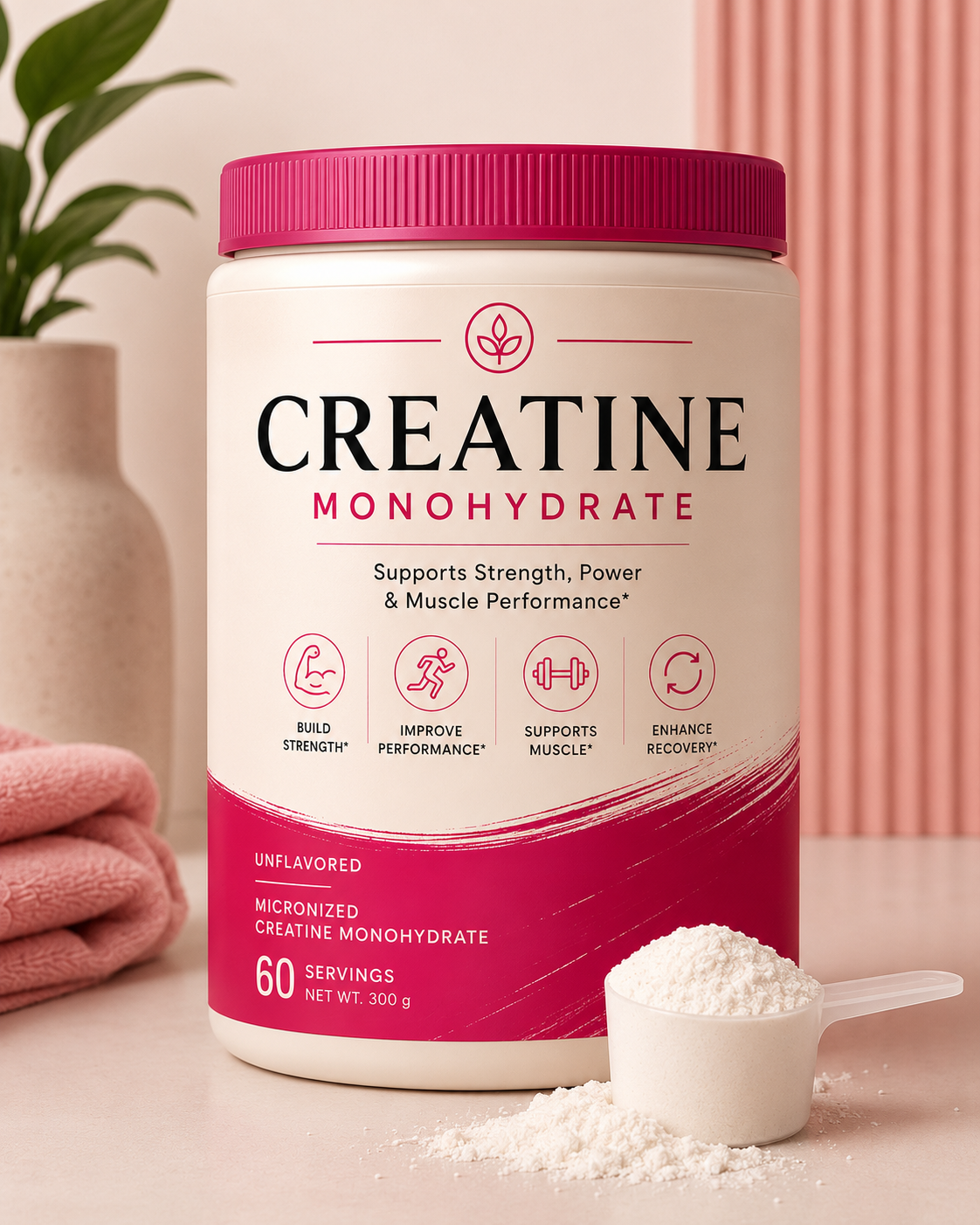
Creatine for Women
A complete evidence based guide to creatine, muscle, strength, training, perimenopause, menopause, body composition, cognition, food, healthy ageing and everyday life.
Creatine is part of normal human biology
Creatine is synthesized mainly from the amino acids arginine, glycine and methionine through processes involving the kidneys, liver and other tissues. It travels through the blood and is taken up by tissues, with the large majority of the body’s creatine pool held in skeletal muscle.
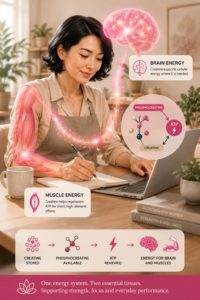
Inside muscle, creatine and phosphocreatine form a rapid energy buffer. During short periods of high energy demand, phosphocreatine helps regenerate ATP from ADP. ATP is the immediate energy currency cells use to perform work.
Creatine does not replace training. It helps support the energy system that lets muscle repeatedly do demanding work, which is one reason the combination of creatine and progressive resistance training matters.
What You Can Do Today
- Name your outcome. Strength, training performance, muscle preservation or another clear goal.
- Build the foundations. Progressive resistance training, enough protein, enough total food, sleep and recovery.
- If creatine fits, keep it simple. Creatine monohydrate is the default with the deepest research base.
- Track something meaningful. Loads, repetitions, strength, function and how consistently you can train.

Where creatine comes from
The human body makes creatine, and diet supplies additional creatine. Meat and fish are the main natural dietary sources. Plant foods contain little to no creatine, which is why vegetarians and vegans often have lower baseline muscle creatine stores than omnivores and can show a larger rise in tissue creatine after supplementation.
This is an important example of why Sophora looks beyond the supplement bottle. Creatine sits at the intersection of amino acid metabolism, food culture, dietary pattern, muscle physiology and cellular energy.
The phosphocreatine and ATP system
Muscle contraction requires ATP. The amount of immediately available ATP is small. Phosphocreatine acts as a rapidly available phosphate reserve that helps restore ATP during brief, intense work. Increasing muscle creatine stores through supplementation can increase phosphocreatine availability and support repeated bouts of high intensity effort.
The global evidence lens
Creatine research is international, but it is not geographically or demographically balanced. Much of the supplementation literature comes from North America, Europe, Brazil and Australia, with additional research from Asia and other regions. Women remain underrepresented relative to men, and women specific intervention evidence from many African countries and parts of Asia and Latin America remains limited. Sophora names those gaps rather than using weak studies simply to fill a continent.
If strength is your goal
The strongest practical case for creatine is its ability to support training performance and adaptation. When creatine helps you perform a little more high quality work, that can support the training stimulus that builds strength and lean tissue over time.
What the evidence supports
Creatine combined with resistance training can improve strength and lean mass outcomes in many populations. Effects vary with age, training status, programme quality, dose and individual response.
Who may care most
Women beginning resistance training, women wanting to preserve muscle with age, vegetarians and vegans with lower dietary creatine exposure, and women seeking better repeated high intensity training capacity.
What to expect
Creatine is not a sensation like caffeine. Benefits are judged through training quality and progress over weeks and months.
What still matters more
A progressive programme, adequate protein and enough energy intake remain foundational. Creatine adds to the system rather than replacing it.
Creatine works best when your muscles have a reason to adapt
For healthy ageing, resistance training is not only about appearance. Strength supports carrying, lifting, climbing stairs, getting off the floor, maintaining independence and protecting physical reserve.
Sophora Approach
- Train major movement patterns two or more times per week if appropriate for you.
- Progress gradually by increasing load, repetitions, range or control.
- Distribute adequate protein across the day.
- Use creatine consistently rather than chasing perfect timing.
- Measure function and strength, not only body weight.

Why perimenopause and menopause change the conversation
Women move through major hormonal transitions across the lifespan. Menstrual cycling, pregnancy, postpartum physiology, perimenopause and postmenopause can alter sleep, training capacity, body composition and musculoskeletal priorities. The female specific creatine literature is growing, but it is still smaller than the literature in men.
In midlife, the practical relevance is clear even when a claim is not menopause specific. Preserving muscle and strength becomes increasingly important with age. Resistance training, protein and adequate nutrition form the base. Creatine can be layered onto that base to support training and lean tissue goals.
Perimenopause
If sleep, hot flushes or heavy bleeding are disrupting recovery, address those drivers as well. Creatine cannot replace treatment for the symptom that is actually limiting you.
Postmenopause
Strength, muscle and bone become central healthy ageing priorities. Creatine can support the muscle side of the plan, especially alongside resistance training.
Bone
Research has explored whether creatine combined with resistance training can influence bone outcomes. Findings are not as consistent as the evidence for muscle and strength, so bone health still requires its own complete plan.
Everyday function
The outcome is not merely gym performance. It is maintaining the physical capacity to live the life you want.
Will creatine make you gain weight?
Creatine can increase body weight, especially early in use, because increased muscle creatine storage is accompanied by water. This is not the same thing as gaining body fat.
For some women the scale change is small. Others notice it more. A loading phase can produce a faster change because muscle stores rise more quickly. Starting with a steady daily maintenance dose usually produces a more gradual saturation.
If the scale worries you
Track waist, clothing fit, training performance and strength alongside weight. A single number cannot distinguish water, muscle and fat.
Should you stop?
If the change is tolerable and your goal is strength or training support, early water related weight alone is not evidence of fat gain. If it meaningfully affects your wellbeing, you can reassess the dose and whether creatine earns its place for you.
Creatine is also part of brain energy metabolism
The brain uses substantial energy, and the creatine system is present in neural tissue as well as muscle. Research has explored cognition, sleep deprivation, mood and neurological contexts. Some findings are encouraging, particularly when brain energy demand is high or baseline creatine availability is lower, but the evidence is less settled than the muscle and performance literature.
For brain fog in midlife, keep the pathway broad. Sleep disruption, iron deficiency, thyroid disease, depression, medication effects, migraine and menopause symptoms can all matter. Creatine can be one tool without becoming the explanation for every cognitive complaint.
Vegetarian and vegan women have a distinct starting point
Because meat and fish are the principal dietary creatine sources, vegetarian and vegan diets generally provide little preformed creatine. The body still synthesizes creatine, but baseline muscle creatine can be lower. Supplementation can therefore produce a larger increase in muscle creatine stores in some vegetarians.
This does not make plant based diets deficient diets. It means dietary pattern changes exposure to one naturally occurring compound, which is relevant when deciding whether supplementation fits a particular goal.
Creatine in food
Fish and red meat are among the richer natural sources. Cooking can reduce some food creatine through conversion and losses. Reaching supplemental study doses through food alone can require substantial quantities of animal foods, so supplementation provides a practical route for people who want a defined dose.
The simplest evidence based approach
| Decision | Practical answer | Why |
|---|---|---|
| Form | Creatine monohydrate | It has the deepest evidence base and is usually cost effective |
| Daily dose | Commonly 3 to 5 g daily | Consistent use gradually raises tissue creatine stores |
| Loading | Optional | It saturates stores faster but is not required for long term benefit |
| Timing | Choose a time you will remember | Consistency is more important than a mythical perfect minute |
| With food | Fine if convenient | It can be mixed into a routine that supports adherence |
| Hydration | Drink normally according to thirst and activity | Creatine does not require ritualistic overhydration |
If a loading phase is used, research protocols often use around 20 g daily divided into smaller doses for about 5 to 7 days, followed by maintenance. Loading is not necessary. A steady 3 to 5 g daily approach reaches saturation more gradually.
Use the right safety question
Creatine monohydrate has a substantial safety literature in healthy people at recommended doses. The useful question is not whether creatine is inherently dangerous. It is whether your health context changes the decision.
Kidney disease
Creatine metabolism produces creatinine, a marker commonly used in kidney assessment. Existing kidney disease changes the supplementation decision and deserves individual clinical guidance.
Blood tests
Tell the clinician interpreting kidney related blood tests that you use creatine. Creatinine can be influenced by muscle mass and creatine intake, so context matters.
Pregnancy and breastfeeding
Creatine has important biological roles and active research interest in pregnancy, but routine supplementation recommendations require stronger human evidence. Use pregnancy specific guidance rather than extrapolating from sports studies.
Medicines and medical conditions
If you have a condition affecting kidney function or fluid balance, or use medicines that affect kidney function, make the decision within that clinical context.
Should you take creatine?
You resistance train and want strength or lean tissue support
Start here: creatine monohydrate is a well supported option alongside progressive training and adequate protein.
You are vegetarian or vegan and train
Start here: your lower dietary creatine exposure makes supplementation especially relevant to consider.
You want healthy ageing but do not resistance train
Start here: build the training and nutrition foundation. Creatine can support the system, but it does not replace the stimulus.
You want creatine only for brain fog or sleep
Start here: investigate the likely driver while recognising that brain creatine research is an active and promising field.
Creatine compared
| Tool | Main job | How it differs |
|---|---|---|
| Creatine | Rapid cellular energy support and training adaptation | Supports the phosphocreatine system |
| Protein powder | Convenient dietary protein | Provides amino acids for tissue building and repair |
| Collagen peptides | Provides collagen derived amino acids and peptides | Different target biology, including connective tissues |
| Magnesium | Essential mineral physiology | Supports many enzyme, nerve and muscle processes but does not replace creatine |
| BCAAs | Selected essential amino acids | Usually less useful when total high quality protein intake is already adequate |
| HMB | Leucine metabolite studied for muscle preservation | Different evidence base and use cases |
What creatine does not do
Creatine makes women bulky.
Creatine does not create large muscles without the training, nutrition, genetics and time required for muscle growth.
Creatine weight gain means fat gain.
Early scale increases commonly reflect water associated with increased creatine storage. That is different from body fat.
You must load creatine.
Loading is optional. A consistent maintenance dose can raise stores more gradually.
Creatine is only for athletes.
Its best established applications grew from exercise science, but strength and muscle function matter far beyond competitive sport.
More expensive creatine forms are automatically better.
Plain creatine monohydrate remains the evidence based default. Novel branding does not automatically produce better outcomes.
How to buy creatine without paying for theatre
Look for a product that clearly states creatine monohydrate and the amount per serving. Prefer transparent manufacturing and credible independent quality testing where available.
Good label
Clear ingredient, clear dose, clear serving size, credible quality information.
Marketing noise
Proprietary blends, vague “advanced matrix” language, unnecessary stimulants and premium pricing without evidence of superior outcomes.
If you are starting today
- Week 1: choose two or three realistic resistance training sessions, review protein intake and define the outcome you will track.
- Weeks 2 to 4: use creatine consistently if it fits. Track training, repetitions, loads, recovery and any scale change without assuming water is fat.
- Weeks 6 to 12: judge the whole system. Has strength improved? Is training progressing? If not, inspect the programme, nutrition, recovery and consistency.
- Beyond 12 weeks: continue what earns its place. Keep the plan simple enough to live with.
Remember This
Creatine is a naturally occurring part of human energy biology, not merely a gym product. Women deserve access to that evidence without having to inherit a male fitness culture to use it.
Build strength for the life ahead of you. Use creatine if it helps that system work better. Measure what matters, and keep what earns its place.
Creatine may be one tool. Midlife health is the larger system.
Strength, sleep, body composition, bone health, hot flushes, mood and cognitive changes can overlap without sharing one solution. Follow each concern into the pathway that gives it the right answer.
Continue through Sophora
Perimenopause
Understand changing symptoms and build a decision pathway around what is actually happening.
Menopause
Connect symptom care with long term muscle, bone, cardiovascular and metabolic health.
Magnesium Glycinate
Understand mineral physiology, food, supplementation and where magnesium fits.
Collagen
Explore connective tissue biology, food, skin, joints and collagen peptides.
Creatine questions women ask
What is the best creatine for women?
Plain creatine monohydrate is the evidence based default. Women do not require a special pink branded form.
How much creatine should a woman take?
A common maintenance intake is 3 to 5 grams daily. Loading is optional.
Will creatine make me gain fat?
Creatine can increase body water and therefore scale weight, especially early on. That is not the same as gaining body fat.
Can women take creatine during perimenopause?
Creatine can be relevant to midlife strength and training goals. It is best used as part of a broader plan that includes resistance training, protein, recovery and appropriate care for disruptive menopause symptoms.
Do vegetarians benefit from creatine?
Vegetarians and vegans generally consume little preformed creatine and often have lower baseline muscle creatine stores, making supplementation particularly relevant to consider.
Do I need to cycle creatine?
Routine cycling is not required to make creatine monohydrate work. Consistent use is the usual approach.
How Sophora built this pillar
This guide uses four evidence layers: global human research where credible evidence exists, female biology and physiology, nature and food context, and clinical medicine. It also draws on exercise science, nutrition and cellular energy biology.
Geographical reality: the creatine evidence base is not evenly distributed across continents. Research from North America, Europe, Brazil and Australia is prominent, with relevant work from Asia and elsewhere. Women specific evidence from many African settings and several other underrepresented regions remains sparse. Sophora treats that as a research gap rather than pretending every region has equivalent evidence.
Core references
- Smith-Ryan AE, Cabre HE, Eckerson JM, Candow DG. Creatine Supplementation in Women’s Health: A Lifespan Perspective. Nutrients. 2021;13(3):877.
- Kreider RB, Kalman DS, Antonio J, et al. International Society of Sports Nutrition position stand: safety and efficacy of creatine supplementation in exercise, sport, and medicine. Journal of the International Society of Sports Nutrition. 2017.
- Antonio J, Candow DG, Forbes SC, et al. Common questions and misconceptions about creatine supplementation: what does the scientific evidence really show? Journal of the International Society of Sports Nutrition. 2021.
- de Guingand DL, et al. Risk of adverse outcomes in females taking oral creatine monohydrate: a systematic review and meta-analysis. Nutrients. 2020.
- Candow DG, Forbes SC, Chilibeck PD, Cornish SM, Antonio J, Kreider RB. Reviews of creatine supplementation, ageing musculoskeletal health and resistance training.
- Avgerinos KI, Spyrou N, Bougioukas KI, Kapogiannis D. Effects of creatine supplementation on cognitive function of healthy individuals: a systematic review of randomized controlled trials. Experimental Gerontology. 2018.
- Burke DG, Chilibeck PD, Parise G, Candow DG, Mahoney D, Tarnopolsky M. Research examining creatine supplementation and training responses in vegetarians.
- Rawson ES, Venezia AC. Use of creatine in the elderly and evidence for effects on cognitive function in young and old. Amino Acids. 2011.
- Wyss M, Kaddurah-Daouk R. Creatine and creatinine metabolism. Physiological Reviews. 2000.
- Persky AM, Brazeau GA. Clinical pharmacology of the dietary supplement creatine monohydrate. Pharmacological Reviews. 2001.
Evidence note: Outcomes supported strongly in exercise and muscle research should not automatically be transferred to cognition, mood, sleep, pregnancy or bone. Those questions have their own evidence bases and remaining research gaps.
Your next step
- Choose the goal that brought you here.
- Build the training, protein and recovery foundation.
- If creatine fits, use plain monohydrate consistently.
- Track the outcome that matters to you and reassess.