
By Sophora Editorial · Evidence reviewed · Published June 2026 · Last reviewed June 2026
You cannot reach behind your back to do up your bra anymore. Lifting your arm above your shoulder has started to hurt in a way that feels deep, the kind of ache that lives in the joint itself.
Your doctor may have called it frozen shoulder, given you some stretches, and sent you on your way.
Nobody mentioned that this is happening at the exact same time as your periods have gone strange, your sleep has changed, and you feel like a different person than you did two years ago. There is a reason for that.

Is frozen shoulder linked to perimenopause?
Yes. Frozen shoulder is significantly more common in women going through perimenopause, with research showing it affects women aged 40 to 60 far more than any other group. Falling oestrogen reduces collagen production and increases inflammation in joint tissue, making the shoulder capsule more prone to thickening and stiffening during this stage.
Frozen Shoulder vs Rotator Cuff Injury in Perimenopause
Both can cause shoulder pain at this stage of life, but they behave differently and need different approaches. Here is how to tell them apart.
| Sign | Frozen Shoulder | Rotator Cuff Injury |
|---|---|---|
| Onset | Gradual, over weeks to months, often with no clear cause | Often sudden, sometimes linked to a specific movement or strain |
| Range of motion | Stiff in all directions, including when someone else moves your arm for you | Weak in specific movements, but passive range of motion is usually normal |
| Pain pattern | Deep, constant ache, often worse at night | Sharp pain with specific movements like lifting or reaching overhead |
| Typical course | Three distinct phases over 12 to 24 months: freezing, frozen, thawing | Varies — can resolve in weeks with rest or require longer rehabilitation |
| The only way to know | A physical examination by your doctor or physiotherapist, sometimes with imaging to rule out other causes. | |
What is actually happening in your body
Falling oestrogen reduces collagen synthesis throughout your body, and the shoulder capsule a thin layer of connective tissue surrounding the joint is particularly vulnerable to this change.
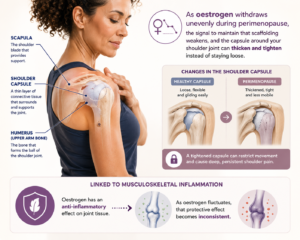
Think of collagen as scaffolding that has kept your joints flexible and well-lubricated for decades.
As oestrogen withdraws unevenly during perimenopause, the signal to maintain that scaffolding weakens, and the capsule around your shoulder joint can thicken and tighten instead of staying loose.
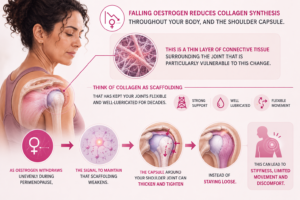
This is also linked to musculoskeletal inflammation more broadly. Oestrogen has an anti-inflammatory effect on joint tissue, and as it fluctuates, that protective effect becomes inconsistent.
The autonomic nervous system ,the part of you that runs background processes without asking permission also registers this joint stiffness as a stress signal, which can make the pain feel sharper and more persistent than a typical muscular ache.
Research from Duke University and other clinical centres has documented this pattern clearly: frozen shoulder affects women in perimenopause and early menopause at notably higher rates than men of the same age or younger women, pointing directly to the hormonal connection.
Your shoulder is not falling apart on its own. It is one of the first places your body shows you that the same hormone managing your cycle is also managing the tissue holding your joints together.
Someone important to you needs this too.
The Complete Picture: Joints, Collagen and Hormonal Change
Frozen shoulder develops in perimenopause because falling and fluctuating oestrogen reduces collagen synthesis and increases inflammation in joint connective tissue, and the shoulder capsule is especially susceptible due to its limited blood supply and reliance on consistent collagen turnover.
This means frozen shoulder rarely appears alone many women notice stiffness building in other joints around the same time, particularly hands, hips, or the other shoulder, as the same hormonal shift moves through connective tissue system-wide.
A natural follow-up question is whether HRT can help. Some research suggests restoring oestrogen levels may reduce the severity or duration of frozen shoulder, though it works best alongside a specialist who understands your whole hormonal picture, not the joint in isolation.
Why your doctor may not have told you this
A frozen shoulder diagnosis is straightforward to make and frequently treated as an isolated orthopaedic issue physiotherapy, sometimes a steroid injection, sometimes simply time.
The connection to perimenopause is well documented in research but does not always make it into a standard doctor appointment, where the focus stays on the joint itself rather than what might be driving it.
Bad luck, or wear and tear that is often as far as the conversation goes. The hormonal piece was missing from that conversation. That gap is not yours to carry.
What this means for the rest of what you are feeling
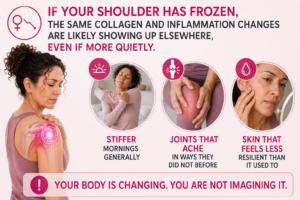
If your shoulder has frozen, the same collagen and inflammation changes are likely showing up elsewhere, even if more quietly.
You might be noticing stiffer mornings generally, joints that ache in ways they did not before, or skin that feels less resilient than it used to.
One oestrogen shift, moving through connective tissue throughout your body, with your shoulder simply being where it became impossible to ignore first.
Questions you may be asking
Is frozen shoulder linked to perimenopause?
Yes. Frozen shoulder is significantly more common in women aged 40 to 60, with falling oestrogen reducing collagen production and increasing joint inflammation as key contributing factors. This is well documented in research but rarely discussed in routine doctor appointments.
How long does frozen shoulder last in perimenopause?
Frozen shoulder typically progresses through three phases over 12 to 24 months: freezing, frozen, and thawing. The hormonal backdrop of perimenopause does not necessarily shorten or lengthen this timeline, but addressing the underlying inflammation may ease severity during the process.
Can HRT help with frozen shoulder?
Some research suggests restoring oestrogen levels through HRT may reduce inflammation and support collagen production, potentially easing frozen shoulder symptoms. It is not a guaranteed treatment and works best as part of a broader conversation about your hormonal picture with a specialist.
You now know: Frozen shoulder in your 40s and 50s is strongly linked to falling oestrogen and reduced collagen production — there is a real reason behind it.
One thing to do: Mention the hormonal connection to your doctor or physiotherapist if it has not come up — it may shape how your treatment plan is approached.
Hold onto this: Your shoulder told you something true. It just needed the rest of the picture to make sense.
Someone important to you needs this too.
The next step
Your shoulder is one part of a bigger picture your joints, your skin, your sleep, all the changes you have been living through with no map for any of it. Sophora draws that map for you. Not a general guide. Your specific picture. Four steps. One session.
When→Where→What→Reveal
Your shoulder and your cycle were never two separate stories. You just had not been given the one that connects them.
Last reviewed: June 2026 · Review due: September 2026 · Not therapy. Not medical advice. For your own use and understanding only. · mysophora.com