
By Sophora Editorial · Evidence reviewed · Published June 2026 · Last reviewed June 2026
Your bra has started to feel wrong. Not the wrong size, just wrong too tight in a way it never used to be, every movement landing somewhere tender. Some days it is a dull ache. Other days it is sharp enough to stop you reaching for something on a shelf.
You have checked for lumps, found none, and still the soreness keeps coming back. Nobody warned you that perimenopause could feel like this, in a part of your body you thought you already understood.
Can perimenopause cause breast pain?
Yes. Breast pain affects up to 70 percent of women during perimenopause, making it one of the most common — and least discussed — symptoms of this stage. Erratic oestrogen and progesterone levels cause breast tissue to swell and become tender, often more intensely or unpredictably than the cyclical soreness you may have known in your twenties and thirties.
Perimenopause Breast Pain vs Early Pregnancy Breast Pain
Both can cause real, noticeable tenderness, and the overlap is exactly why this question comes up so often. Here is how they actually differ.
| Sign | Perimenopause Breast Pain | Early Pregnancy Breast Pain |
|---|---|---|
| Pattern | Increasingly random as cycles become irregular, not tied to a predictable point each month | Steady and building, often starting within a week or two of conception |
| Associated symptoms | Hot flushes, irregular periods, mood shifts, sleep changes | Missed period, nausea, fatigue, frequent urination |
| Sensation | Aching, burning, stabbing, or a feeling of tightness or fullness | Heaviness and tingling, nipples often more sensitive than usual |
| Duration | Can persist intermittently for years through perimenopause, usually easing after menopause | Often eases after the first trimester as hormone levels stabilise |
| The only way to know | A pregnancy test or blood test, especially if your cycle is still irregular rather than absent. | |
What is actually happening in your body
As ovulation becomes irregular during perimenopause, progesterone production declines while oestrogen continues to fluctuate, leaving oestrogen relatively unopposed and intensifying breast sensitivity.
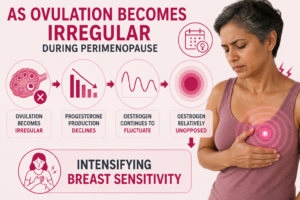
Oestrogen and progesterone have worked together for decades to manage the monthly swelling and softening of breast tissue.
When progesterone drops out of that balance unevenly, oestrogen’s stimulating effect on breast tissue and the milk ducts goes unchecked, producing swelling, tenderness, and sometimes a feeling of fullness that has nothing to do with your bra size changing.
The connective tissue supporting your breasts is also sensitive to these hormonal shifts. As oestrogen fluctuates and gradually declines overall, that supporting tissue can offer less structural support than it used to, which can add to the ache, particularly later in the day or after physical activity.
Some women also develop fibrocystic changes small, benign, fluid-filled cysts during this stage, which can make breast tissue feel lumpier and more tender, especially as hormone levels shift week to week.
According to research from the Cleveland Clinic, breast pain is significantly more common during perimenopause than after menopause, since the hormonal turbulence driving it largely settles once oestrogen reaches a lower, steadier baseline.
Your breasts are not malfunctioning. They are responding to a hormonal balance that has held steady for decades, now tipping unevenly as one half of that partnership steps back before the other.
Someone important to you needs this too.
The Complete Picture: Hormones, Breast Tissue and What Changes
Breast pain in perimenopause happens because declining progesterone leaves oestrogen’s effect on breast tissue unopposed, and because connective tissue offering structural support becomes less resilient as oestrogen fluctuates overall.
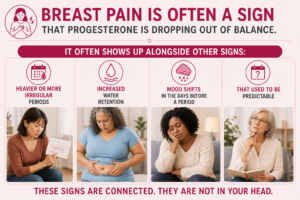
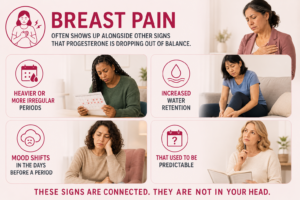
This means breast pain often shows up alongside other signs that progesterone specifically is dropping out of balance heavier or more irregular periods, increased water retention, and mood shifts in the days before a period that used to be predictable.
A natural follow-up question is whether this means something is wrong. For most women it does not breast pain is rarely an early indicator of breast cancer but any new lump, persistent localised pain confined to one specific spot, or skin changes over the breast should always be checked by a doctor rather than assumed to be hormonal.
Why your doctor may not have told you this
Breast pain in a perimenopause-age appointment often gets a quick reassurance,” common, usually benign, nothing to worry about.”
That reassurance, while accurate, can leave the actual mechanism unexplained.
The progesterone-oestrogen imbalance driving the pain rarely gets named specifically, partly because a short appointment has limited time and partly because breast pain is treated as a minor symptom compared to hot flushes or sleep disruption.
“Just hormones” is often where the conversation stops, with no explanation of which hormone, or why it feels different now than it did at twenty-five. That gap is not yours to carry.
What this means for the rest of what you are feeling
If your breasts have become unpredictably tender, the same progesterone decline is likely showing up elsewhere too.
You might be noticing heavier or more irregular periods, increased bloating, or mood swings that feel less predictable than they used to. One hormone falling out of balance with oestrogen, showing up across several systems that all depended on that same steady partnership.
Questions you may be asking
Can perimenopause cause breast pain?
Yes. Breast pain affects up to 70 percent of women during perimenopause, driven primarily by declining progesterone leaving oestrogen’s effect on breast tissue unopposed. It often feels different from earlier cyclical soreness less predictable, sometimes more intense.
Is perimenopause breast pain usually in one breast or both?
Both is most common, though one-sided pain happens too and does not automatically signal a problem. Hormonal breast pain can affect breast tissue unevenly. New, persistent pain confined to one specific area, especially alongside a lump or skin change, is worth having checked.
Does breast pain go away after menopause?
For most women, yes breast pain becomes rare once you have reached menopause, since the hormonal turbulence driving it settles once oestrogen reaches a lower, steadier baseline. Some women using hormone therapy after menopause may still experience tenderness as a side effect.
You now know: Breast pain in perimenopause is driven by declining progesterone leaving oestrogen unregulated not a random or unexplained symptom.
One thing to do: Track when the soreness is worst against your cycle for a few weeks the information can help you firat ,then your doctor understand what is actually happening.
Hold onto this: Your body was not malfunctioning. It was telling you something that comes with nature.
Someone important to you needs this too.
The next step
Your breast pain is one part of a bigger picture — your cycle, your hormones, your mood, all the changes you have been living through with no map for any of it. Sophora draws that map for you. Not a general guide. Your specific picture. Four steps. One session.
When→ Where→ What→ Reveal
Your body was not malfunctioning. It was telling you something true.
Last reviewed: June 2026 · Review due: September 2026 · Not therapy. Not medical advice. For your own use and understanding only. · mysophora.com