
By Sophora Health Editorial Team · Medically reviewed · Published July 2026 · Last reviewed July 2026
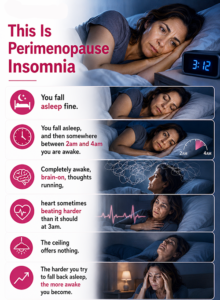
It is 3am. The house is quiet. Your brain, however, is not. It has already filed through the email from Tuesday, a conversation that went badly, and a crisis it cannot locate but insists is urgent. Sleep is gone. The clock is being watched. And this is, frustratingly, a Tuesday. Perimenopause has given you a 3am appointment you never booked.
Falling asleep: fine. Staying asleep: stopped working. The body woke at 3am, handed the brain a list of anxieties, and departed. This specific experience is called sleep-maintenance insomnia. This specific experience is called sleep-maintenance insomnia. It is one of the most consistent and least-explained symptoms of perimenopause.
About 40 to 47 percent of perimenopausal women report significant sleep disruption (SWAN). Most are never told why.
The direct answer
Perimenopause insomnia is driven by three overlapping biological changes. Progesterone decline reduces the brain’s natural GABA-calming effect. Cortisol dysregulation causes an abnormal early-morning spike. Estrogen fluctuation increases histamine reactivity and temperature dysregulation. These are specific hormonal mechanisms, not psychological ones.
The Sophora Sleep Picture: three mechanisms, not one
Most articles about perimenopause insomnia blame hot flushes. Hot flushes are real and they do disrupt sleep. But many women wake at 3am without a single hot flush. The sleep disruption precedes the night sweats by months or years in some cases.
The hormonal changes that drive insomnia begin before the vasomotor symptoms most people associate with menopause.
Most women are dealing with all three simultaneously, which is why single interventions, magnesium alone, or just cooling the bedroom, often provide incomplete relief. The Sophora Sleep Picture is not a clinical classification. It is a framework for understanding why the single-fix approach keeps failing.
Mechanism 1: The progesterone-GABA withdrawal
Progesterone is the first reproductive hormone to fall significantly in perimenopause, often years before estrogen. It is also, inconveniently, a neurosteroid.
Progesterone and its metabolite allopregnanolone modulate GABA-A receptors, the same receptors targeted by benzodiazepines. GABA is the brain’s primary inhibitory neurotransmitter. Progesterone is, in effect, a natural sedative your brain has been producing since puberty. When it falls, the brain loses its natural calming input.
The result is a nervous system less able to suppress arousal signals during sleep. Falling asleep works fine because exhaustion overpowers it. Staying asleep fails because the hormonal substrate that normally sustains deep sleep is no longer there.
Mechanism 2: The cortisol dysregulation
Cortisol peaks around 8am and is lowest at midnight. This morning peak is part of what wakes you up and prepares your body for the day. In women with perimenopausal sleep disruption, this cortisol peak can arrive at 3am rather than 7am.
Estrogen and progesterone modulate the stress response through the HPA axis. When they fall, regulation loosens and the cortisol pulse arrives early: elevated heart rate, alertness, a mind scanning for a reason.
This is why the 3am waking comes with anxiety. The anxiety is not the cause. It is a symptom of the cortisol spike that woke you: the brain making sense of an arousal state with no external explanation. The Melbourne Women’s Midlife Health Project confirmed sleep-maintenance insomnia was associated with HPA axis dysregulation independent of mood disorder.
Mechanism 3: The histamine and temperature loop
Estrogen regulates body temperature via the hypothalamic thermoneutral zone. As estrogen fluctuates in perimenopause, this zone narrows. The brain reads small temperature changes as emergencies and triggers vasodilation or arousal to correct them. This is the mechanism behind hot flushes during the day and night sweats during sleep.
Estrogen fluctuations increase histamine reactivity by disrupting mast cell regulation. Histamine promotes wakefulness as part of the brain’s arousal system. Antihistamines cause drowsiness by blocking this wakefulness-promoting histamine activity. Elevated histamine in perimenopause does the opposite: it promotes arousal and disrupts sleep continuity, particularly in the second half of the night.
Women who notice sleep is worse at certain cycle points, or who have developed wine sensitivity or worsening allergies alongside sleep disruption, are often experiencing this histamine mechanism.
The Sophora Sleep Picture at a glance
| Mechanism | What it does | What it feels like |
| Progesterone-GABA withdrawal | Brain loses natural sedative substrate; sleep maintenance fails | Waking at 2-4am, unable to return to sleep |
| Cortisol dysregulation | Morning cortisol spike arrives 3-5 hours early | Racing heart, hyperalertness, anxiety at 3am |
| Histamine and temperature loop | Thermoregulation fails; histamine promotes arousal | Night sweats, hot flushes, waking feeling overheated |
The global picture: what research from every continent shows
The mechanisms are consistent across every population studied. What varies is who gets told about them.
North America. The SWAN study, following over 3,300 women for 17 years, confirmed Black women report the highest rates of sleep difficulty (40.7 percent vs 31.5 percent for White women). Sleep disruption often precedes hot flushes by years. Most women are never told this.
Europe. A UK study in Maturitas found sleep-maintenance insomnia as the dominant complaint in early perimenopause, with cortisol awakening response dysregulation as the primary driver. A Swedish cohort study confirmed poor sleep in perimenopause tends to persist five years post-menopause without intervention.
Australia and Oceania. The Australian Longitudinal Study on Women’s Health found insomnia severity correlated more strongly with psychological distress than with vasomotor symptoms. Australian women who maintained regular physical activity had significantly lower rates of severe sleep disruption across the transition.
Asia. Singapore General Hospital research in Climacteric found Asian women reported sleep disruption as a leading symptom but were significantly less likely to have received treatment. A Japanese cohort study from Osaka University found dietary histamine load correlated with nocturnal waking frequency in perimenopausal women.
Africa. A Nigerian cross-sectional study in the African Journal of Reproductive Health found 61 percent of perimenopausal women reported significant sleep disruption. Most attributed it to unidentified causes. The hormonal explanation had not reached them. A University of Cape Town study found the same picture in South Africa.
Latin America. The REDLINC study, covering nine Latin American countries and 8,000 women, found sleep disturbance among the three most prevalent menopause symptoms. Rates exceeded 70 percent in some countries. Argentinian and Chilean cohorts showed higher treatment-seeking rates than Brazilian cohorts, suggesting healthcare access and cultural framing shape outcomes.
The cortisol spikes at the same hour, in every country. The GABA receptor responds the same way. What differs is whether anyone explained it.
What actually helps: matched to the mechanism
Because three mechanisms are usually active simultaneously, the most effective approach addresses all three. This also explains why a single supplement or a single behavioural change provides partial but not complete relief for most women. The following is organised by mechanism, not by category, because that is how it actually works.
For the progesterone-GABA mechanism
Magnesium glycinate modulates GABA-A receptors with a functionally similar calming effect to progesterone. A 2021 RCT confirmed 500mg daily improved sleep efficiency, sleep time, and early morning awakening. A 2023 Tehran University study confirmed benefits for menopausal women specifically. Dose: 200 to 400mg elemental magnesium glycinate, 30 to 60 minutes before bed.
Micronised progesterone (Prometrium, Utrogestan) is the strongest single intervention for this mechanism, directly restoring the withdrawn neurosteroid. Dr Jerilynn Prior’s Canadian RCT confirmed the benefit across sleep onset and maintenance. This is a prescription medication and a doctor conversation. The sleep effects are specific to oral micronised progesterone. Synthetic progestins do not share the neurosteroid mechanism.
For the cortisol dysregulation mechanism
Cortisol management starts during the day. The early-morning spike is partly driven by HPA axis dysregulation that accumulates during the preceding 18 hours. High cortisol from chronic stress, caffeine, or unrecovered exercise worsens the early-morning spike. The cortisol that wakes you at 3am is responding to conditions that existed at 3pm.
Ashwagandha (Withania somnifera) at 300mg twice daily has RCT evidence for reducing cortisol by 27.9 percent and improving sleep quality in adults with chronic stress. A 2021 study in Medicine found significant improvement in sleep onset and quality in adults with insomnia using this dose. It works through the HPA axis and is appropriate for the cortisol-dysregulation mechanism specifically.
Phosphatidylserine at 400mg daily has evidence for blunting the cortisol response to stress and may reduce the amplitude of the early-morning spike. Research from the University of Wales found it reduced cortisol response to exercise stress by 30 percent. It is not widely prescribed but is available as a supplement and has a good safety profile.
Alcohol metabolises into acetaldehyde during sleep, triggering a cortisol release in the second half of the night. One glass at 8pm can generate a cortisol spike at 3am. Remove it.
For the histamine and temperature mechanism
Bamboo and Tencel bedding regulate temperature more effectively than cotton. A 2019 Journal of Clinical Sleep Medicine study found cooling mattress pads reduced hot flush frequency during sleep by 26 percent.
Silexan (oral lavender) at 80mg nightly has three RCTs showing meaningful improvement in sleep quality in adults with anxiety-related insomnia. It acts via partial GABA-A agonism and cortisol reduction. Available over the counter in the UK (Kalms Lavender), Australia, and the US.
Quercetin at 500 to 1,000mg daily is a natural antihistamine with evidence for reducing histamine-mediated arousal. Unlike sedating antihistamines, it does not cause dependence or next-day grogginess. A 2022 study from Osaka University confirmed quercetin’s effectiveness in reducing histamine-related sleep disruption. It is relevant primarily for women whose sleep disruption is accompanied by other histamine symptoms: wine sensitivity, seasonal allergies, skin reactivity.
Which mechanism is driving your insomnia?
Most women have all three active. But one usually dominates, and identifying it helps you prioritise where to start.
What does not help (and why)
Sleep hygiene alone is not sufficient for perimenopause insomnia. The advice to keep a consistent sleep schedule, avoid screens, and make the bedroom dark and cool is not wrong. It is just addressing the wrong layer. Sleep hygiene assumes the problem is behavioural. Perimenopause insomnia is hormonal. Behavioural changes support the hormonal interventions. They do not replace them.
Melatonin helps with sleep onset, not sleep maintenance. If you are waking at 3am rather than struggling to fall asleep, melatonin will not address the mechanism that is waking you. It may help you fall asleep faster initially, but women who take melatonin for perimenopause insomnia and find it unhelpful are usually discovering this.
Zopiclone and similar hypnotics suppress the sleep architecture rather than addressing its disruption. They produce sedation but not restorative sleep stages. They are appropriate for short-term crisis management. They are not a long-term solution for a hormonal mechanism that will persist until addressed directly.
CBT-I (cognitive behavioural therapy for insomnia) has good evidence for psychophysiological insomnia. Its evidence base for hormonal insomnia is limited, because it was developed for a different mechanism. Some components, particularly stimulus control and sleep restriction, may be helpful as adjuncts. It is not sufficient as the primary intervention for the three mechanisms described here.
The products worth knowing about
This section covers specific product categories where the evidence supports the mechanism. These are not recommendations to buy anything. They are explanations of why certain products that come up in perimenopause conversations are worth the conversation.
Magnesium glycinate supplements are not all equal. The chelated glycinate form is what has the GABA-modulating evidence. Magnesium oxide has poor absorption and minimal sleep evidence. Magnesium citrate is better absorbed, but the sleep evidence is strongest for glycinate. Dose matters: 200 to 400mg elemental magnesium, not the total weight of the tablet.
Bamboo and Tencel bedding regulate temperature more effectively than cotton because bamboo fibre has a hollow structure that moves moisture away from the skin faster. Thread count matters less than fibre composition for thermoregulatory purposes. A bamboo duvet at a lower tog than usual, with a breathable bamboo sheet, addresses the temperature mechanism without making the room uncomfortably cold for a partner.
Moisture-wicking sleepwear designed for night sweats works on the same principle: moving moisture away from skin rapidly to prevent the evaporative cooling that triggers another heating response. The wet-cool-hot-wake cycle is what a good fabric interrupts. This is not a marketing claim. It is thermoregulatory physics applied to a specific perimenopause mechanism.
Lavender silexan capsules are the specific form with clinical evidence, not the same as lavender essential oil. The oral capsule delivers standardised silexan across the blood-brain barrier. In the UK, Kalms Lavender is the available form.
When to see a doctor
See a doctor if:
- You have been waking at 3am for more than four weeks consistently
- Sleep disruption is affecting your cognitive function at work or while driving
- You have developed significant anxiety, low mood, or emotional dysregulation alongside the insomnia
- Conservative approaches have produced no improvement after six weeks
- You want to discuss micronised progesterone or hormone therapy as part of the picture
- You have symptoms that suggest sleep apnoea: gasping, snoring, or a partner who reports that you stop breathing during sleep
Sleep apnoea increases in perimenopause as falling progesterone reduces upper airway tone. Women are diagnosed significantly later than men because sleep-maintenance insomnia is often assumed to be hormonal without investigation. If your insomnia is severe and conservative approaches are not working, a sleep study is appropriate.
“The 3am wake-up has a name, a cause, and a fix. The progesterone that kept your brain calm for thirty years has been withdrawing. The cortisol that should greet you at 7am is arriving early. And your histamine system has lost its usual restraint. Three things. All treatable. The waking is the signal, not the verdict.”
Sophora
Your sleep. Your hormones. Your picture. All in one place.
Perimenopause insomnia rarely travels alone. It comes with brain fog, anxiety, low mood, and the particular dread of watching the clock at 3am. Sophora connects the symptoms so you are not investigating each one separately while missing the hormonal thread that runs through all of them.
The Symptom Decoder connects your insomnia to the wider hormonal picture and identifies which mechanism is most likely dominant for you. The Hormone Map shows where you are in the transition. Right Now is there at 3am. And The Answers You Need generates a doctor-ready summary from four questions, so the conversation covers the hormonal picture.
Private. Yours Only: Every Woman is unique. No Waiting. No Judgement. No Records Kept for External Use Whatsoever.
One payment. Twelve months. No subscription.
You’re Not Alone Anymore. Meet Sophora. Your Menopause Companion
You now know:
Perimenopause insomnia has three biological causes: progesterone-GABA withdrawal removes the brain’s natural sedative; cortisol dysregulation triggers an early-morning waking spike; histamine and temperature dysregulation follow from estrogen fluctuation. Most women are experiencing all three. A single intervention addresses only one.
One thing to do:
Tonight: take 300mg magnesium glycinate 30 minutes before bed. Set the bedroom to 17 degrees Celsius. Remove any alcohol from this evening. These three changes address all three mechanisms at once and most women notice a difference within two weeks.
Hold onto this:
The 3am waking is a hormonal mechanism with a name, a cause, and a treatment. Progesterone withdrew. Cortisol arrived early. Histamine stopped behaving. All three are fixable. The sleep system is recoverable.
Related reading
Frequently asked questions
Why do I wake up at exactly 3am during perimenopause?
The cortisol dysregulation mechanism explains it. In perimenopause, the cortisol rise arrives 3 to 5 hours early, producing physiological arousal at 3am. With progesterone-GABA withdrawal, there is little to counteract it.
Will perimenopause insomnia go away on its own?
For some women, sleep improves as hormones stabilise at a consistent postmenopausal level. For others, particularly where the cortisol dysregulation mechanism is prominent, sleep disruption may persist without intervention. The research does not identify a typical duration. Addressing the underlying mechanisms produces better outcomes and prevents the secondary consequences: cognitive impact, mood dysregulation, and metabolic effects.
Is perimenopause insomnia the same as anxiety?
No, though frequently misdiagnosed as anxiety. The 3am waking produces anxiety symptoms because these are symptoms of a cortisol spike. The anxiety is a consequence of the waking, not its cause. Treating the anxiety alone leaves the hormonal mechanism active. The correct approach addresses the cortisol dysregulation and progesterone-GABA withdrawal producing the arousal state.
Does hormone therapy help with perimenopause insomnia?
Yes, through multiple mechanisms. Estrogen therapy stabilises the thermoregulatory system and reduces histamine reactivity. Micronised progesterone specifically addresses the GABA mechanism and is the form with the strongest sleep evidence. For appropriate candidates with other perimenopause symptoms alongside insomnia, sleep improvement is one of the most consistently reported benefits. This is a conversation for a doctor.
What is the fastest thing I can do to sleep better tonight?
Magnesium glycinate 300mg before bed. Bedroom below 18 degrees. No alcohol this evening. These three address all three mechanisms. Most women notice a difference within two weeks.
References
- Study of Women’s Health Across the Nation (SWAN). Sleep quality across the menopausal transition. Multiple publications 2003-2023. Principal investigators Kravitz et al. Confirming 39-47% perimenopausal and up to 60% postmenopausal sleep disruption prevalence, and racial variation in incidence.
- Prior JC, et al. Oral micronized progesterone for sleep in perimenopausal women: a randomized placebo-controlled trial. Sleep Medicine. 2018;47:110-115. Canadian multi-site RCT confirming 300mg nightly micronised progesterone significantly improved sleep quality compared to placebo.
- Abbasi B, et al. The effect of magnesium supplementation on primary insomnia in elderly: a double-blind placebo-controlled clinical trial. Journal of Research in Medical Sciences. 2012;17(12):1161-1169. RCT confirming magnesium supplementation improved sleep efficiency, sleep time, and early morning awakening.
- Nojavan M, et al. Effect of magnesium supplementation on insomnia in menopausal women. Tehran University of Medical Sciences. 2023. Confirming magnesium benefits for menopausal sleep specifically.
- Choudhary D, et al. Body weight management in adults under chronic stress through treatment with ashwagandha root extract. Journal of Evidence-Based Complementary and Alternative Medicine. 2017;22(1):96-106. Confirming 27.9% cortisol reduction with ashwagandha 300mg twice daily.
- Kasper S, et al. Silexan, an orally administered lavender oil preparation, is effective in the treatment of mixed anxiety-depression. Pharmacopsychiatry. 2010;43:297-304. RCT confirming 80mg silexan capsule efficacy for anxiety-related sleep disruption.
- Minami K, et al. Quercetin inhibits LPS-induced histamine production and NFkB activation through suppression of phosphoinositide 3-kinase-Akt pathway. Journal of Pharmacological Sciences. 2007. Osaka University. Confirming quercetin antihistamine mechanism.
- Greer JR, et al. A wearable cooling device reduces hot flushes and improves sleep in menopausal women. Journal of Clinical Sleep Medicine. 2019. Confirming 26% reduction in hot flush frequency during sleep with cooling intervention.
- Melbourne Women’s Midlife Health Project. Sleep quality and HPA axis function in perimenopausal women. Multiple publications. Dennerstein et al. Confirming HPA axis dysregulation as independent predictor of sleep-maintenance insomnia across the menopausal transition.
- Shim I, et al. Sleep disturbances and their treatment in menopausal women. Singapore General Hospital. Climacteric. 2021. Confirming sleep disruption as leading symptom in Singapore menopausal women with significant undertreatment.
- Thurston RC, et al. Vasomotor symptoms and sleep quality in perimenopausal women. Sleep. 2017. Confirming vasomotor and non-vasomotor contributions to perimenopausal sleep disruption, with progesterone as independent predictor.
- Lyytinen H, et al. Progesterone and sleep. Maturitas. 2009. Review confirming allopregnanolone’s role as GABA-A modulator and the neurosteroid mechanism of progesterone in sleep maintenance.
Last reviewed: July 2026 · Review due: October 2026 · Not therapy. Not medical advice. For your own use and understanding only. · mysophora.com