
By Sophora Editorial · Evidence reviewed · Published June 2026 · Last reviewed June 2026
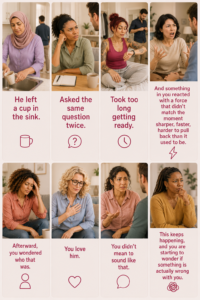
He left a cup in the sink. Asked the same question twice. Took too long getting ready. And something in you reacted with a force that didn’t match the moment sharper, faster, harder to pull back than it used to be.

Afterward, you wondered who that was. You love him. You didn’t mean to sound like that. This keeps happening, and you are starting to wonder if something is actually wrong with you.
You did not mean to sound like that. And this keeps happening.
You are not losing your mind. You are not a bad partner. There is a specific, biological reason this is happening, and knowing it changes everything about how you carry it.
Is menopause anger toward your husband actually real?
Irritability and anger affect around 80% of perimenopausal women, making it one of the most common and least discussed symptoms of the transition. The anger that arrives disproportionately, quickly, and without your full consent is not a character flaw surfacing under pressure.
It is a neurological response to hormonal disruption. Understanding the mechanism does not excuse every sharp word. But it does make it considerably harder to conclude that you have simply become a difficult person.
What is actually happening in your body
Fluctuating oestrogen during perimenopause directly affects serotonin, a mood-balancing brain chemical, while also making the amygdala ;the brain’s threat and emotional-response centre which is more reactive to stress and frustration.
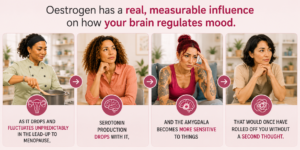
Oestrogen has a real, measurable influence on how your brain regulates mood. As it drops and fluctuates unpredictably in the lead-up to menopause, serotonin production drops with it, and the amygdala becomes more sensitive to things that would once have rolled off you without a second thought.
Progesterone plays a separate but related role. It has a naturally calming effect on the nervous system, and as it declines during perimenopause, cortisol the body’s primary stress hormone tends to rise to fill that gap.
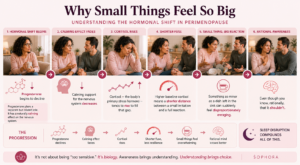
Higher baseline cortisol means a shorter distance between a small irritation and a full reaction, which is part of why something as minor as a dish left in the sink can suddenly feel disproportionately enraging, even though you know, rationally, that it shouldn’t.
Sleep disruption compounds all of this. According to HealthCentral, more than 40% of perimenopausal women report sleep disturbances tied to hot flushes and night sweats, and poor sleep has been consistently linked with increased emotional dysregulation and lower frustration tolerance meaning the same hormonal shifts disrupting your sleep are also independently shortening your fuse, stacking two separate mechanisms on top of each other rather than just one.
What is happening in the brain
Oestrogen regulates serotonin, the brain chemical most involved in mood stability and emotional regulation. When oestrogen levels swing unpredictably during perimenopause, serotonin production becomes erratic.
Less serotonin means a lower threshold for frustration, a reduced capacity to pause before reacting, and a heightened sensitivity to things that previously registered as minor. The cup in the sink is not the problem.
The brain’s ability to process the cup in the sink without staging a small crisis has been chemically compromised. It used to file it under irrelevant. Now it does not know where to put it.
Progesterone compounds it. In a normal cycle, progesterone in the second half produces a calming effect through its influence on GABA receptors in the brain, the nervous system’s quietening system. When progesterone declines during perimenopause, that calming buffer goes with it.
The window between stimulus and reaction narrows to approximately zero. The Australasian Menopause Society describes mood disturbances in this transition as tending toward anger rather than sadness, arriving as an on-off phenomenon lasting minutes to hours before resolving. Similar to PMS in quality, but without the predictability of PMS, which at least had the decency to arrive on a schedule.
Poor sleep makes all of this significantly worse. Over 40% of perimenopausal women report significant sleep disruption. Chronic sleep deprivation reduces activity in the prefrontal cortex, the part of the brain responsible for emotional regulation and impulse control, while increasing reactivity in the amygdala, the brain’s alarm centre.
A woman simultaneously managing hormonal mood dysregulation and sleep-deprived impaired judgment is dealing with a significant double load. The sharpness that comes out is the result of that load. It is not evidence of who this woman is. It is evidence of what this woman is carrying.
The anger is real. The reason it is there is biological. What you do with that understanding is yours to decide. But you deserved to have the information first.
You did not stop being yourself. The part of your brain that decides what counts as worth reacting to simply started reacting sooner than it used to.
Someone important to you needs this too.
The Complete Picture: What This Means for Your Marriage
Understanding the hormonal mechanism behind your anger does not remove your responsibility for how you treat your husband it gives you a real explanation to work with instead of confusion or shame, which makes it easier to act on rather than be ruled by.
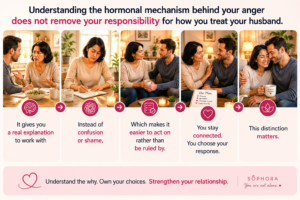
This distinction is important. A biological explanation is not a free pass; it is information. Knowing that your amygdala is more reactive right now does not mean every outburst was justified, but it does mean you are not simply “becoming a worse person,” which is a fear many women quietly carry during this stage.
Worth knowing too: a 2025 study presented by The Menopause Society, tracking 500 women aged 35 to 55, found that trait anger the lasting, personality-level kind, separate from momentary irritability actually decreased with age through the menopause transition rather than increasing. The short-fuse reactivity many women describe in the moment is real, but it does not necessarily mean you are becoming an angrier person overall.
This is experienced differently around the world
The biology of perimenopausal mood disruption is the same everywhere. The cultural context around expressing and managing it is not.
In many South Asian, East Asian, and African cultural contexts, there is significant social pressure on women in midlife to manage emotional expression within strict parameters. The anger that perimenopause produces in these contexts is not less real. It is more suppressed, which tends to produce a different kind of damage to both the woman and the relationship. Some research suggests cultures where menopause is framed as a positive transition, including some Mayan communities in Mexico and West African groups where postmenopausal women gain social status and authority rather than losing relevance, report fewer mood symptoms. Which is a finding worth sitting with: the experience the body is having is the same. What culture tells you to expect from it changes what you experience. The hormonal mechanism is the same. The psychological context around it changes what gets amplified.
In Japan, where emotional containment is culturally expected, mood symptoms during menopause are less commonly reported than in Western populations. Whether this reflects fewer symptoms or fewer reported symptoms remains an open question. It is possible to have the experience and not name it.
Many women around the world are expert at this, which helps nobody. Australia and New Zealand, with their relatively direct approach to menopause discussion, show some of the highest rates of women seeking help for mood-related menopause symptoms globally.
This is almost certainly because the conversation is allowed to happen, not because Australian and New Zealand women are angrier. Access to language for the experience shapes what women can do with it. Name the thing. Then address the thing.
What actually helps
Addressing the hormonal root
HRT is the most effective treatment for perimenopausal mood symptoms driven by oestrogen and progesterone fluctuation. For many women, stabilising the hormonal environment significantly reduces the frequency and intensity of the anger response. Micronised progesterone specifically, taken at bedtime, supports GABA activity and often produces a noticeable reduction in reactive irritability. If mood symptoms are significantly affecting your relationship and your quality of life, this conversation with a menopause-trained clinician is the most important one to have. It is a shorter conversation than most women expect. It does not require you to have it all figured out before you walk in.
SSRIs and SNRIs
For women who cannot use HRT or whose mood symptoms are severe, SSRIs and SNRIs have evidence for reducing perimenopausal irritability and mood instability through the serotonin pathways that oestrogen was previously supporting. These are not antidepressants being used off-label in a vague way. They are specifically addressing the neurotransmitter disruption that oestrogen fluctuation creates.
CBT adapted for menopause
Cognitive behavioural therapy specifically designed for menopause symptoms has strong evidence for reducing the distress and reactivity associated with mood changes. It does not remove the hormonal driver, but it significantly changes the relationship between the trigger and the response, which in a relationship context is often what matters most.
Sleep
Improving sleep quality reliably reduces the intensity of emotional reactivity. Any investment in addressing the hormonal or physical causes of sleep disruption during perimenopause is also an investment in the relationship. The two are not separate problems.
The conversation with him
It does not have to be a long conversation. It can be: “I am in perimenopause. The hormonal changes are affecting my mood in ways that feel out of proportion to what triggered them. It is biological and it is being treated. I am telling you so that when it happens, you know it is not about you and not the truth of how I feel about you.” That is enough to change the dynamic. The partner who understands what is happening can stop taking it personally. The partner who stops taking it personally stops withdrawing. The cycle breaks. It is a remarkably short conversation for how much it accomplishes.
When to see a doctor
If the anger is more than episodic, if there is a sustained low mood, persistent anxiety, or a sense of emotional flatness that does not lift, this warrants clinical assessment rather than solo management. Sophora’s Doctor Prep document can help you describe your mood symptoms clearly and specifically, including when they arrive, how long they last, and how they are affecting your relationships, so you arrive at that appointment with a picture your doctor can actually work with.
Why your doctor may not have told you this
Anger specifically tends to get less airtime in a standard appointment than hot flushes, sleep, or low mood, partly because it is an emotion many women feel uncomfortable admitting to a doctor, and partly because it does not fit neatly into the symptoms a short consultation is built to screen for first. If you have felt embarrassed bringing this up, or never brought it up at all, that gap reflects how little space this specific symptom is given in typical care, not a sign you are alone in experiencing it.
What this means for the rest of what you are feeling
If anger has become harder to manage, it is worth knowing this sits within the same broader hormonal picture as other changes you may have noticed — disrupted sleep, lower patience generally, even physical symptoms like hot flushes that arrive alongside the emotional ones. Oestrogen, progesterone, serotonin, and cortisol are all part of the same interconnected system, so when one shifts, the others tend to move with it.
Questions you may be asking
Is menopause anger toward your husband actually real?
Yes. Irritability is the primary mood complaint for up to 70% of women during perimenopause, driven by a documented hormonal mechanism affecting serotonin and the brain’s emotional-response centre.
Is this anger a sign there is a problem with my marriage?
The anger itself is not evidence of a relationship problem. It is evidence of hormonal disruption. That said, it can cause relationship problems if it is not understood and not addressed. The distinction matters: the anger is manageable through treatment. But a relationship that does not survive the information that this is happening was already carrying other weight.
Will this anger eventually go away?
For many women, mood symptoms ease once hormone levels settle at a lower, steadier baseline after menopause. A 2025 study also found trait anger tends to decrease, not increase, with age through this transition , the intense in-the-moment reactivity is real, but it is not necessarily your new permanent baseline.
How long will this last?
Mood symptoms during perimenopause typically follow the transition, which lasts an average of 7 to 10 years. With treatment, most women find significant improvement within weeks to months.
Without treatment, the hormonal volatility eases after menopause for most women, though not all. Either way, this is not who you are for the rest of your life. It is what is happening right now, in this specific hormonal chapter, which has an end.
Should I tell him what is happening?
Yes. Not because you owe him an explanation for every reaction, but because having the correct information changes how both of you experience what is happening. A partner who understands that this is hormonal, biological, and being managed can respond with patience rather than withdrawal. That changes everything about the dynamic.
What actually helps with menopause-related anger?
Hormone replacement therapy, prioritising sleep, and talk therapy or cognitive behavioural therapy all have real evidence behind them for managing this symptom. Tracking your patterns can also help identify whether certain times of day or specific triggers make outbursts more likely.
You now know: Your anger has a real, named hormonal mechanism — oestrogen, the amygdala, serotonin, and cortisol working together, not a personal failing.
One thing to do: Try naming it out loud to your husband once, in a calm moment — “this is hormonal, and I’m working on it” changes the conversation for both of you.
Hold onto this: You did not stop being yourself. Your reactions just got faster than your intentions for a while.
Someone important to you needs this too.
The next step
This is one piece of a bigger pattern. Symptom Decoder turns what you’re feeling into what’s likely causing it — and what tends to follow. Sophora starts with your Hormone Map™ — a plain-language picture of what’s actually happening in your body, built from what you share. Private. Account-bound. Never sold, never used for advertising, never used to train public AI models.
mysophora.com · One payment. Twelve months. No subscription.
You did not stop being yourself. Your reactions just got faster than your intentions for a while.
Last reviewed: June 2026 · Review due: September 2026 · Not therapy. Not medical advice. For your own use and understanding only. · mysophora.com