
By Sophora Editorial · Evidence reviewed · Published June 2026 · Last reviewed June 2026
Your ears have been itching for weeks now, deep in a place you cannot quite reach, in a way that has nothing to do with infection or wax. It’s Itchy Ears during Perimenopause.
You mentioned it to your doctor and got a blank look back. You searched it online at midnight and landed on pages about swimmer’s ear, none of it close to what is actually happening.
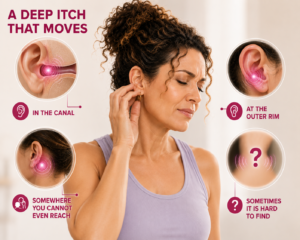
There are two things going on at once. Your ears and your hormones have never been put together for you. They are connected.
Is itchy ears a perimenopause symptom?
Yes. Itchy ears are a recognised, though rarely discussed, hormonal symptom of perimenopause. Falling oestrogen reduces collagen and moisture in skin throughout the body, including the delicate lining of the ear canal, which produces a persistent itch that ear drops and antihistamines typically do not resolve.
Itchy Ears vs Ear Infection in Perimenopause
Both can cause discomfort in or around your ear, but they feel different and need different responses. Here is how to tell them apart.
| Sign | Hormonal Itch (Perimenopause) | Ear Infection |
|---|---|---|
| Sensation | Dry, persistent itch, often deep in the canal | Pain, pressure, sometimes throbbing |
| Discharge | None. The skin is dry, not wet | Often present, sometimes with odour |
| Timing | Persistent over weeks or months, often worse at night | Sudden onset, often within a day or two |
| Response to treatment | Ear drops and antihistamines rarely help | Improves with antibiotic or antifungal treatment |
| The only way to know | An examination by your doctor, especially if pain, discharge, or hearing changes are present. | |
What is actually happening in your body
Falling oestrogen reduces collagen synthesis and slows down your sebaceous glands. This is the skin’s built-in moisturising system and the lining of your ear canal is thin enough that this change becomes noticeable fast.
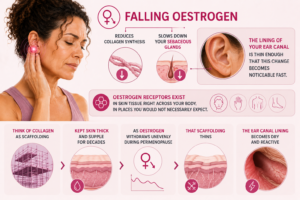
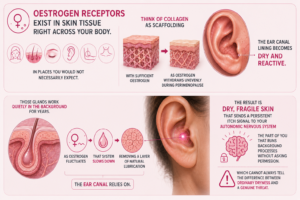
Oestrogen receptors exist in skin tissue right across your body, in places you would not necessarily expect. Think of collagen as scaffolding that has kept skin thick and supple for decades . As oestrogen withdraws unevenly during perimenopause, that scaffolding thins, and the ear canal lining becomes dry and reactive.
Those glands work quietly in the background for years. As oestrogen fluctuates, that system slows down, removing a layer of natural lubrication the ear canal relies on. The result is dry, fragile skin that sends a persistent itch signal to your autonomic nervous system the part of you that runs background processes without asking permission, and which cannot always tell the difference between ordinary dryness and a genuine threat.
Clinical research into menopause and skin health confirms oestrogen has well-documented effects on skin thickness and moisture right across the body, including places that rarely come up in conversation.
Your ears were never the problem on their own. This is the same hormone that manages your cycle stepping back from skin tissue everywhere, and your ear canal simply happens to be one of the thinnest, most sensitive places it shows up first.
Someone important to you needs this too.
The Complete Picture: Skin, Hormones and Where the Itch Shows Up
Itchy ears in perimenopause happen because falling oestrogen reduces collagen production and sebaceous gland activity in skin tissue throughout your body, and the ear canal lining is thin enough to register this change earlier and more noticeably than thicker skin elsewhere.
This means the itch rarely stays isolated to your ears .Many women notice the same dryness pattern building on the scalp, around the eyes, or on the inner arms around the same time. A natural follow-up question is whether moisturising products can help.
Topical treatment can ease the surface dryness, but because the underlying cause is hormonal rather than purely external, relief tends to be temporary unless the broader hormonal picture is addressed.
Why your doctor may not have told you this
When you describe an itchy ear to your doctor, the usual checklist runs through wax, infection, or eczema, with a referral to a specialist if none of those fit.
The connection to perimenopause and oestrogen withdrawal is rarely part of that pathway not because your doctor is wrong, but because training on hormonal skin symptoms outside the obvious areas is limited, and a short appointment leaves little room for a wider conversation.
Ear drops, antihistamines, or a shrug that it is probably nothing that is usually where it ends. None of that addressed what was actually happening. That gap is not yours to carry.
What this means for the rest of what you are feeling
If your ears are itching, the same mechanism is likely showing up elsewhere, even if you have not connected it yet. You might be noticing dry, itchy skin on your face or scalp, increased sensitivity in your nose, or a dry, gritty feeling in your eyes. One hormone withdrawing from skin tissue everywhere, landing wherever your skin happens to be thinnest.
Questions you may be asking
Is itchy ears a perimenopause symptom?
Yes. Itchy ears with no infection or wax buildup are a recognised hormonal skin symptom of perimenopause. Falling oestrogen reduces collagen and sebaceous gland activity, drying out the sensitive lining of the ear canal in a way that ear drops typically cannot fix.
Why do my ears itch more at night during perimenopause?
Oestrogen follows a daily rhythm and tends to dip further in the evening, which can make already-dry skin more reactive at night. Cortisol dysregulation, common in perimenopause, also tends to peak during disrupted sleep, which can heighten how strongly you notice the itch.
Will itchy ears go away after menopause?
For many women, skin symptoms including ear itch settle once oestrogen levels stabilise at a lower, steadier baseline after menopause rather than fluctuating unpredictably. Some dryness may persist without hormonal support, so addressing the underlying picture tends to bring more lasting relief than treating the ear alone.
You now know: Itchy ears in perimenopause are a skin symptom caused by falling oestrogen, not an ear problem on its own.
One thing to do: If you bring this up with your doctor, name the mechanism directly — oestrogen withdrawal affecting skin in the ear canal — rather than just describing the itch.
Hold onto this: Your ears were never the problem. The explanation was just missing. You have it now.
Someone important to you needs this too.
The next step
Your ears are one part of a bigger picture .Your skin, your sleep, your joints, all the changes you have been living through with no map for any of it. Sophora draws that map for you. Not a general guide. Your specific picture. Four steps. One session.
When→Where→ What→ Reveal
Your ears were never the problem. The explanation was just missing. You have it now.
Last reviewed: June 2026 · Review due: September 2026 · Not therapy. Not medical advice. For your own use and understanding only. · mysophora.com