
By Sophora Editorial · Evidence reviewed · Published June 2026 · Last reviewed June 2026
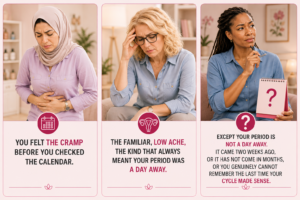
You felt the cramp before you checked the calendar. The familiar, low ache, the kind that always meant your period was a day away.
Except your period is not a day away. It came two weeks ago, or it has not come in months, or you genuinely cannot remember the last time your cycle made sense. The cramping is real.
The explanation you have been given is, “it’s just hormones” has never actually told you why.
Why do I have cramps during perimenopause?
Perimenopause cramps happen because fluctuating oestrogen increases your body’s production of prostaglandins the chemicals responsible for uterine contractions even when no period follows.
Unlike the predictable cramps you may have known for decades, these can strike between periods, before periods that never quite arrive, or with no period at all, because the hormonal trigger and the bleeding itself have become disconnected.
Perimenopause Cramps vs Familiar Period Cramps
Cramps are not new to you. What is new is how unpredictable they have become. Here is how the two actually compare.
| Sign | Perimenopause Cramps | Familiar Period Cramps |
|---|---|---|
| Timing relative to bleeding | Can occur with no period at all, or days/weeks before or after one | Reliably accompanies or immediately precedes bleeding |
| Location | Often described as more one-sided, closer to the ovaries | Typically centred, lower abdomen |
| Intensity pattern | Can be stronger or more erratic than cramps you have known for years | Generally consistent month to month |
| Underlying driver | Anovulatory cycles and oestrogen spikes triggering prostaglandins without ovulation completing | Predictable prostaglandin release tied to shedding the uterine lining |
| The only way to know | If cramps are severe, persistent, or paired with heavy bleeding or fever, a doctor should assess them rather than assuming perimenopause by default. | |
What is actually happening in your body
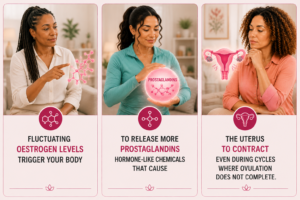
Fluctuating oestrogen levels trigger your body to release more prostaglandins hormone-like chemicals that cause the uterus to contract ,even during cycles where ovulation does not complete.
In your earlier reproductive years, this process followed a clear rhythm: oestrogen rose, prostaglandins followed, your period arrived, the cramping made sense. In perimenopause, that rhythm breaks down because anovulatory cycles, where no egg is released, become increasingly common.
An anovulatory cycle does not mean nothing is happening hormonally. Oestrogen can still spike, sometimes higher than during your regular cycles, because your ovaries are working harder to trigger a response that no longer arrives reliably.
That oestrogen spike can still drive prostaglandin production, and contraction can follow, even without ovulation completing and progesterone rising afterward to balance things out.
This pattern is widely described as a phantom period, though it is worth knowing the research on cramping specifically in anovulatory cycles is less settled than the research on ordinary period cramps.
Your individual experience may not fit a single tidy explanation, and that is normal too.
According to Cleveland Clinic, oestrogen levels during perimenopause may remain elevated for longer after ovulation than they did in earlier reproductive years, which is the direct trigger for the increased prostaglandin release driving these cramps.
Your body was not confused. It went through the whole sequence. The hormonal rise, the chemical signal, the contraction ,it just never finished the part where a period was supposed to follow.
Someone important to you needs this too.
The Complete Picture: Why Cramps Happen Without a Period
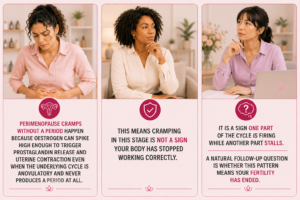
Perimenopause cramps without a period happen because oestrogen can spike high enough to trigger prostaglandin release and uterine contraction even when the underlying cycle is anovulatory and never produces a period at all.
This means cramping in this stage is not a sign your body has stopped working correctly. It is a sign one part of the cycle is firing while another part stalls.
A natural follow-up question is whether this pattern means your fertility has ended. It does not.
Anovulatory,this means menstrual cycle in which the ovaries do not release an egg (ovulation). Because no egg is released, the body cannot produce progesterone, which normally stabilizes the uterine lining.
Cycles are common in perimenopause but inconsistent and some cycles still involve ovulation, which is why pregnancy remains possible throughout this transition even as cramping patterns become harder to read.
Why your doctor may not have told you this
Cramps without a period rarely come up as their own topic in a perimenopause appointment — they tend to get folded into the broader, vaguer explanation of “hormone fluctuation” without the specific prostaglandin mechanism ever being named.
Part of this is time; part of it is that period-pain research has historically focused on regular cycles, leaving the anovulatory pattern less discussed even though it is common at this stage.
You may have been reassured that cramping without bleeding is normal in perimenopause, which is true, without ever hearing the actual reason why. That gap is not yours to carry.
What this means for the rest of what you are feeling
If your cramps have become unpredictable, the same anovulatory pattern is likely behind other changes you have noticed too.
Periods arriving early, late, or not at all, breast tenderness that no longer follows a clear schedule, mood shifts that seem to come from nowhere and these all trace back to the same erratic hormonal sequence, oestrogen rising and falling without the steady completion ovulation used to provide.
Questions you may be asking
Why do I have cramps during perimenopause?
Fluctuating oestrogen triggers increased prostaglandin production, causing uterine contractions even when ovulation does not complete and no period follows. This is sometimes called a phantom period or secondary dysmenorrhea.
Can you have perimenopause cramps with no period at all?
Yes. Cramps can occur during an anovulatory cycle, where oestrogen spikes and triggers prostaglandin release without a period ever arriving. This is a recognised pattern in perimenopause, not a sign anything is wrong on its own.
When should I see a doctor about perimenopause cramps?
If cramps are severe, persistent, or accompanied by heavy bleeding, fever, or unusual abdominal tenderness, they should be assessed rather than assumed to be hormonal. Conditions like fibroids or endometriosis can also cause cramping and are worth ruling out.
You now know: Cramps without a period happen when oestrogen spikes trigger prostaglandins without ovulation completing a real, named mechanism, not a mystery.
One thing to do: Note whether cramps cluster around any pattern at all, even a loose one that detail can help a doctor understand your specific picture.
Hold onto this: Your body finished most of the sequence. It just never needed to finish all of it.
Someone important to you needs this too.
The next step
Your cramps are one part of a bigger picture. Your Cycle, Your Hormones, Your fertility, all the changes you have been living through with no map for any of it. Sophora draws that map for you. Not a general guide. Your specific picture. Four steps. One session.
When→Where→What→Reveal
Your body finished most of the sequence. It just never needed to finish all of it.
Last reviewed: June 2026 · Review due: September 2026 · Not therapy. Not medical advice. For your own use and understanding only. · mysophora.com